Constellation d'un morcellement : séquence 7
2026 · Red and black Indian ink and acrylic on old exercise-book paper · 21 x 26.5 cm
€350
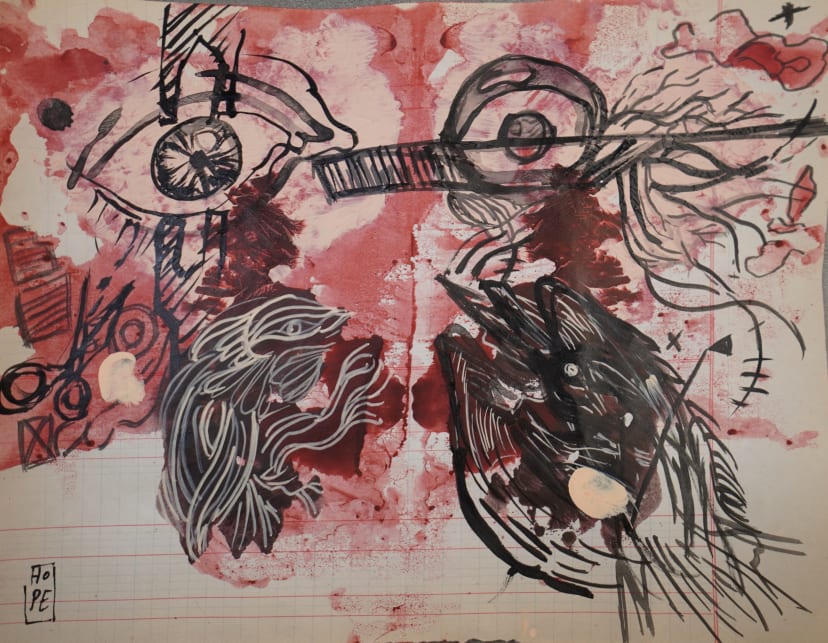
In sequence 7, the red stains answer each other from one half of the sheet to the other, on either side of the fold, as in the test the psychiatrist Hermann Rorschach published in 1921, in which someone is asked what they see in an ink blot. Above, a wide-open eye is pierced by a long hatched bar that runs to a ring, below, two heads face each other, one drawn in white lines and the other in black, like a figure and its negative, and along the edges a pair of scissors, crosses and a row of stitches can be made out. The drawing then puts two questions to the visitor, what has been cut and what has been sewn back. Well, a body, of which the sheet keeps only pieces held at a distance, like the stars of a constellation.
Acquire on ArtsyConstellation d'un morcellement : séquence 6
2026 · Red and black Indian ink and acrylic on old exercise-book paper · 21 x 26.5 cm
€350
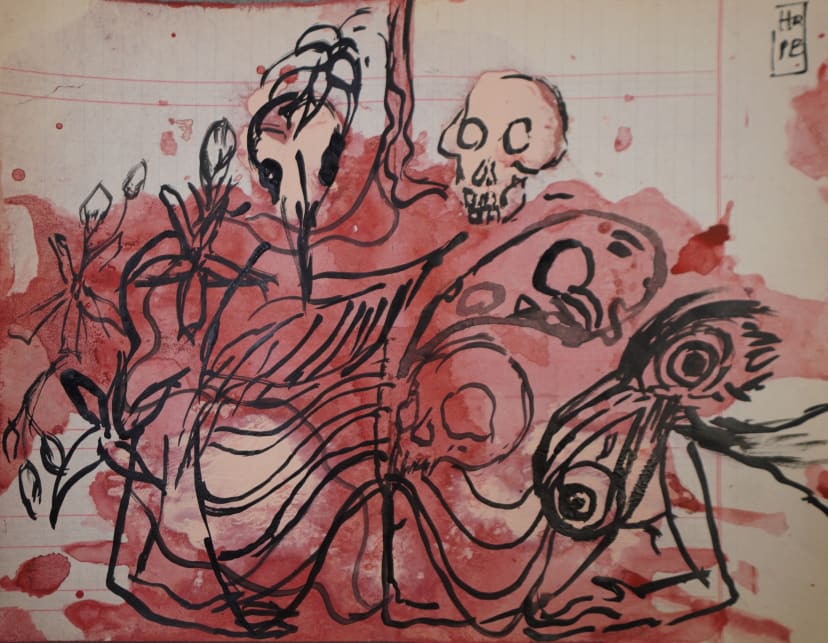
Sequence 6 sets two human skulls and a long-beaked bird's skull floating above a mass of wavy lines, with flowers with closed buds on the left and, on the right, a large bird's head that stares at the viewer with a round eye. Skull and flower are the two signs of the vanitas, the still life that reminded the seventeenth century that beauty passes and death comes. Hope Mokded sets them above lines that look like rough water. From an artist from Gabès who works on exile, skulls floating above waves call to mind the Mediterranean turned into a cemetery. The flowers, for their part, keep their buds closed, like a life that will not have had time to bloom.
Acquire on ArtsyConstellation d'un morcellement : séquence 5
2026 · Red and black Indian ink and acrylic on old exercise-book paper · 21 x 26.5 cm
€350
In sequence 5, a red line drops from the top edge, crossed by short black dashes like a suture, into a large stain where a black wing with grey feathers, a head with a ringed eye and, on the right, a round eye circled twice come together, beneath two touches of yellow acrylic that light up the top of the sheet. The suture, which recurs from one sheet to another, inscribes the gesture of repair in the drawing itself. Here it leads to a wing without a bird, detached from any body, like the remnant of a flight that no longer carries anyone, under the twice-circled eye that stares at the visitor.
Acquire on ArtsyConstellation d'un morcellement : séquence 4
2026 · Red and black Indian ink and acrylic on old exercise-book paper · 21 x 26.5 cm
€350
Sequence 4 places between two patches of yellow acrylic, on which foliage is drawn, a horse's head with staring eyes that dominates the sheet, with a small naked female body beneath its nostrils, while at the upper left a horned head opens its jaws and on the right flowers and a branch spill out of the red stain. Art history has an image for this encounter, The Nightmare, painted by Johann Heinrich Füssli in 1781, in which a horse's head with bulging eyes looms above a sleeping woman on whom a demon has sat down. Hope Mokded keeps the horse's head and the horned creature, but the woman is now no more than a small standing figure, tiny beneath the beast's nostrils, in a bad dream the body does not wake from.
Acquire on ArtsyConstellation d'un morcellement : séquence 3
2026 · Red and black Indian ink and acrylic on old exercise-book paper · 21 x 26.5 cm
€350
In sequence 3, a red line runs down the middle of the sheet like a spine, with a heart at its top, ribs and bones crowd the right-hand side, and on the left straight lines ending in dots and arrows point at the body like the labels of an anatomical plate. Since Andreas Vesalius's Fabric of the Human Body, in 1543, the anatomical plate has named every part it points to. Here the arrows lead to no word, so that the body, pointed at from all sides, is examined like that of a stranger whose name no one has asked.
Acquire on ArtsyConstellation d'un morcellement : séquence 2
2026 · Red and black Indian ink and acrylic on old exercise-book paper · 26.5 x 21 cm
€350
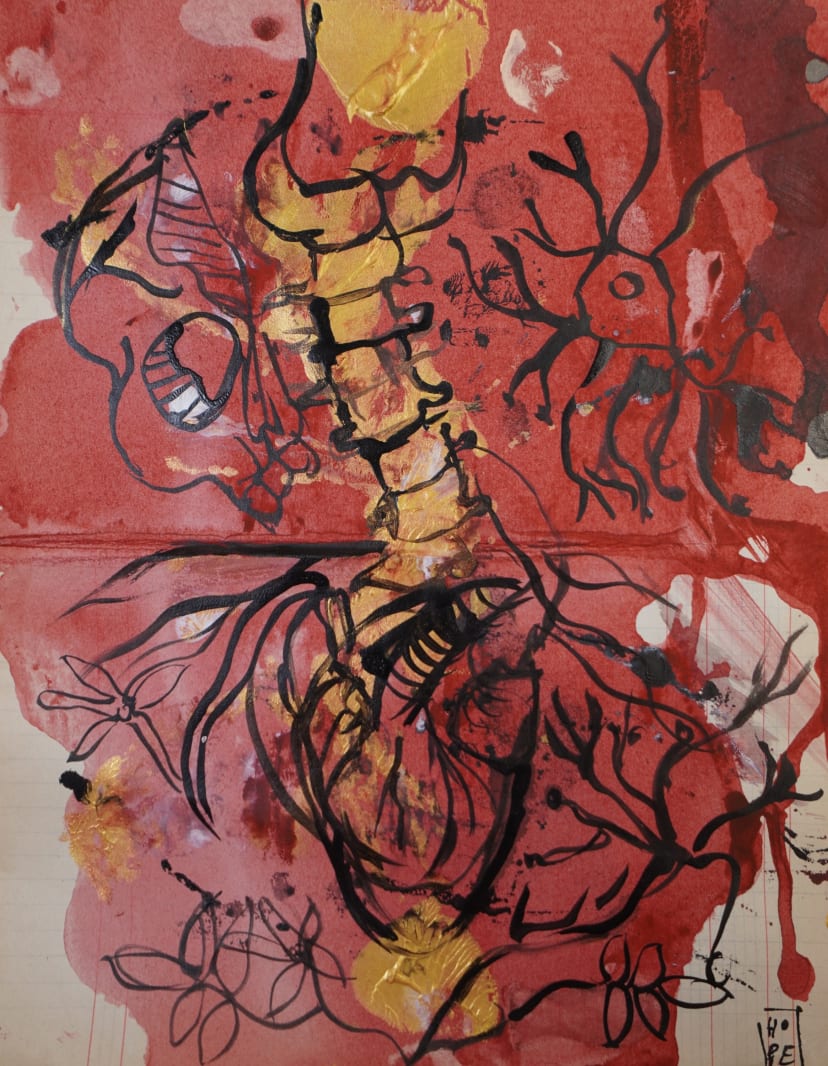
The only upright sheet of the series, sequence 2 is also the most saturated with red. A column of vertebrae runs through it from top to bottom between two patches of yellow acrylic, the fold of the exercise book cuts it halfway down like a fracture, and around it spread ribs, a cell with long branching arms, roots and, at the bottom, five-petalled flowers drawn in a single line. The roots drawn beside the spine take exile at its word, the word uprooting. Hope Mokded thus gives the body the structure of an uprooted plant, whose backbone would be the stem.
Acquire on ArtsyConstellation d'un morcellement : séquence 1
2026 · Red and black Indian ink and acrylic on old exercise-book paper · 21 x 26.5 cm
€350
Sequence 1 spreads a pink wash that lets the lines of the exercise book show through, and a black stem rises through the middle of the sheet, branching like a network of veins, so that plant and bloodstream merge in a single line. On the left, a woman's face with wide-open eyes sheds two tears beside a head with pointed teeth, and on the right a lozenge encloses another shape above a flower opening like a fan. The weeping face and its sharp-toothed neighbour stand side by side like two states of one person, between grief and bite, while the flower opposite opens all the same.
Acquire on Artsy