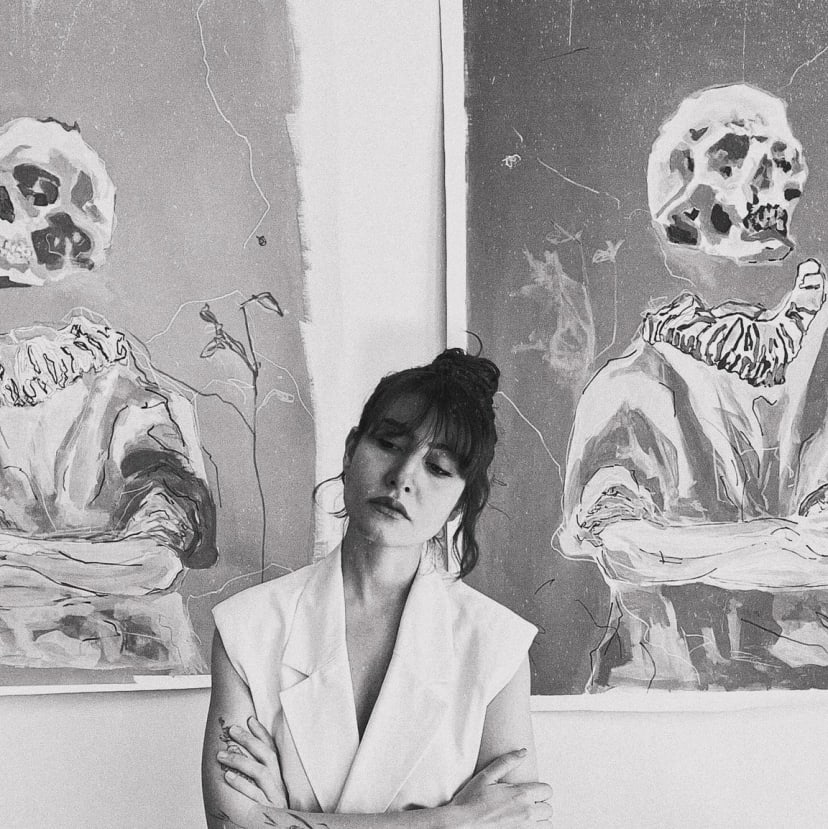
Portraits
Hope Mokded: Brutality as Lucidity
Galerie Les 26 Chaises · 17 April – 3 May 2026 — Red wash, ochre ground, a single figure that returns and refuses to settle: Hope Mokded draws herself again and again, from a hospital bed traversed by the machinery of exile and asylum. Between Christian iconography and raw gesture, a series in which the body refuses to be classified.
By Shiran Ben Abderrazak — On Hope Mokded's series From Exile to Asylum
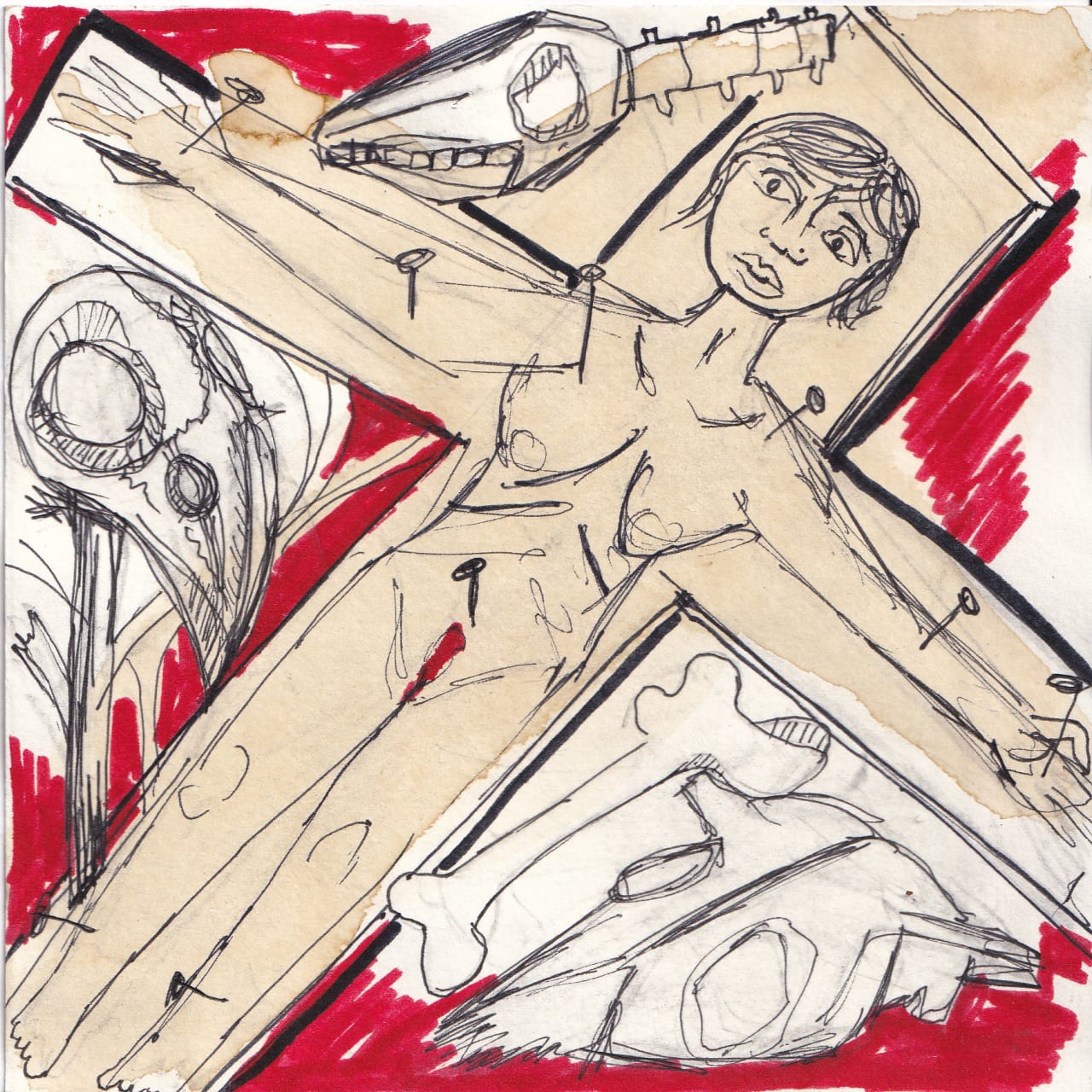
There is, in the recent history of drawing, a lineage that refuses to make violence a subject in order to make it a material. Nancy Spero worked this way, piling up tortured bodies and flying figures, treating the sheet as a battlefield where the line itself is wounded. Käthe Kollwitz had opened this path long before, charging the pencil point with a darkness that illustrates nothing and becomes one with what it shows. Hope belongs to this lineage, from a place of her own: that of a Tunisian African woman who went through art school, settled in Paris, and whose work takes as its terrain administrative precarity, the psychiatric experience and the condition of the migrant body. The series presented at galerie Les 26 Chaises gathers several dozen square-format sheets, worked in ink, wash and gouache, around a precise biographical sequence: a hospitalisation that followed the administrative ordeal of the residence permit. What strikes first is that the artist does not portray others. She stages herself, tirelessly. The figure that returns, alone or multiplied, is her own: asleep among water lilies like an Ophelia who refused to sink, crucified between birds and bones, lying near a skull and an overturned glass as in a profane vanitas, the face in close-up ringed with feathers and crossed by a tear. The self-portrait functions here as a stubborn hypothesis: each sheet is a version, a station, a testing of a figure that can only hold together by exposing itself. The square format tightens, the composition saturates the sheet to its edges, and it is in this frontal density that the strength of the work is played out.
Much has been said, about this type of practice, of art brut. The reference returns ritually whenever a drawing refuses polish, whenever a figure carries the trace of a psychiatric experience, whenever a hand starts to look urgent. Here it is misleading. Art brut, as Dubuffet codified it, presupposed an exteriority to the cultural field, a formal innocence, a line that existed because its author knew no other possibility. Hope went to art school. She knows the expressionist lineage, the controversies around contemporary figuration, the stakes of politically engaged drawing since Spero. Her line is piercing not because she is ignorant of mastery, but because she has weighed its cost. The clumsy stroke is a choice, in the strict sense, a critical stroke: it designates mastery as a convention that the subject at hand makes untenable. One does not neatly draw a night of anguish in a psychiatric hospital without betraying what was at stake there. Hope's 'brutality' is a formal lucidity, not a condition.
It is from this decision that her treatment of violence can be understood. Representing violence is a problem contemporary art solves poorly, caught between the aestheticisation that neutralises it, the frontality that doubles it and the allusion that makes it disappear into understatement. Hope displaces the question by working the material itself. In her work, red is almost never contained within an outline. It becomes flat expanse, becomes ground, rings the figures or runs through them, and its circulation across the sheet recalls less a painted motif than a stain spreading. This fluidity of graphic blood is what prevents the image from functioning as a report of injury observed from a distance: violence is not narrated from outside the frame, it is a regime of the surface, a state of the support, something that happens to the sheet as much as to the body it carries.
This plastic decision takes on its full meaning if one accepts to read the series as a reply to what Foucault called biopower. The modern government of the living operates through apparatuses that sort, classify, treat, count, grant or refuse administrative existence: immigration law, psychiatry, statistics, hygienism. Exile and asylum are two of its clearest figures, and their continuity, in the title chosen by the artist, has the value of a diagnosis. The body that passes through these apparatuses must be legible, classifiable, properly inscribed in the boxes provided for it. Against this, Hope produces deliberately ungovernable bodies, figures that refuse to be smooth, contours that leak, flesh that overflows. The blood-soaked style is not an excess: it is the precise form of a plastic disobedience. Where biopower wants accountable bodies, the sheet produces bodies that soil the account. One then understands why these drawings can be neither well-behaved, nor decorative, nor neatly framed. Cleanliness is the enemy of the thought that carries them.
The singularity of the series is measured by relating it to the rest of the artist's practice. Her large canvases — Cartographie des risques, Les clandestines, L'interminable déambulation à Porte de la Chapelle — proceed by polyphonic accumulation, lending voice to other migrant women, stacking signs and stories until the canvas becomes a choral space. From Exile to Asylum goes the other way. Instead of widening the focus, Hope contracts it until she draws only one figure: herself, taken up sheet after sheet, in postures that summon the Christian iconography of the Passion, the baroque vanitas and the romanticism of Ophelia, without ever submitting to their authority. This passage from chorus to stubborn monologue is not a retreat into intimacy, it is a change of strategy: rather than multiplying voices, the artist multiplies the states of a single body, and it is repetition that becomes the political device. The series functions like a book of hours turned against the institution that sought to hold her.
To situate the way Hope treats violence and the impeded body, a few points of comparison are needed. One thinks of Goya for the way monstrosity surfaces without tipping into spectacle; of Paula Rego, who made narrative drawing a testing ground for the feminine condition, confined bodies, clandestine abortions, without ever yielding to the ease of militant illustration; and of Miriam Cahn, whose watercolours and inks treat war, exile and vulnerable bodies by working dilution as a way of letting violence spread through the sheet rather than containing it in a motif. Hope stands at the intersection of these lineages without letting herself be enclosed in them. Where Rego organises her pieces as constructed theatrical scenes and Cahn maintains an almost abstract distance through the fluidity of her water, Hope draws from a present still warm, without décor or ordering, with visible pentimenti and strokes that do not erase their hesitation. It is this refusal of ordering — theatrical in one, abstract in the other — that makes the specificity of her gesture, far more than the reference to art brut.
What should be retained from this series, beyond its plastic coherence, is the position it holds. Hope does not illustrate the migrant condition, does not testify to psychiatric trauma, does not perform the wounded identity. These registers are already occupied, often well-mapped, sometimes complacent. She does something else: against a power that demands clean bodies she sets a writing that claims overflow, and she does so with means that themselves partake of what they contest — a stroke that overflows, an ink that soils, a sheet that lets itself be traversed.
What remains, after crossing the sheets, is a figure that does not exhaust itself. She lies down, stands up, multiplies, lets the red pass through her, and begins again. One leaves the series with the feeling of having crossed the same face too many times to shake it off on the way out, and it is precisely there that the work operates: not by delivering a narrative, but by installing in the viewer an unease that does not dissipate at the gallery's threshold. This unease is not an effect, it is a method. It obliges the one who looks to carry a little of what the sorting apparatuses would keep out of sight, and it is through this obstinacy of a figure that refuses to fit the box assigned to it that Hope transforms the viewer's experience even as she affirms her own.