Portraits
Sirin Boubaker: Mapping What Remains
Menart Fair Paris · Solo show · 23–25 October 2026 — Seated bodies, floating skulls, flat fields of deep blue and vivid orange: Sirin Boubaker paints the Mediterranean in-between, between a Tunisia left behind and a France inhabited. From the ‘Refused’ stamp to cyanotypes on textile that leave the wall, a practice that does not narrate exile but gives form to what remains — the trace, the fold, memory in progress.
By Shiran Ben Abderrazak
There is, within contemporary art, a discreet lineage of artists for whom the body is neither subject nor pretext, but a site of excavation. Marlene Dumas paints figures saturated with political affect. Kiki Smith fragments anatomy to reveal its structural vulnerability. Sirin Boubaker belongs to this lineage, from a precise place: the Mediterranean in-between, between a Tunisia left behind and a France inhabited, between two temporalities her work does not seek to reconcile but to make coexist on the surface.
Born in 1993 in Kalaat el-Andalous, trained at the Fine Arts school of Nabeul, based in Lyon after a spell in Paris, Sirin works with painting, collage, photomontage and, increasingly, cyanotype on textile. It is this last medium that she presented in the spring of 2026 at Galerie Khal, and the choice is not incidental. The cyanotype, which Anna Atkins used as early as 1843 to fix botanical imprints, is a recording process: sunlight prints the image by contact, the fabric retains the accidents, the folds, the residues of time. What the cyanotype produces, in her practice, is a form of isomorphism between process and subject. The cyanotype does what the painting narrates: it deposits, it sediments, it keeps the trace of what was there without freezing it.
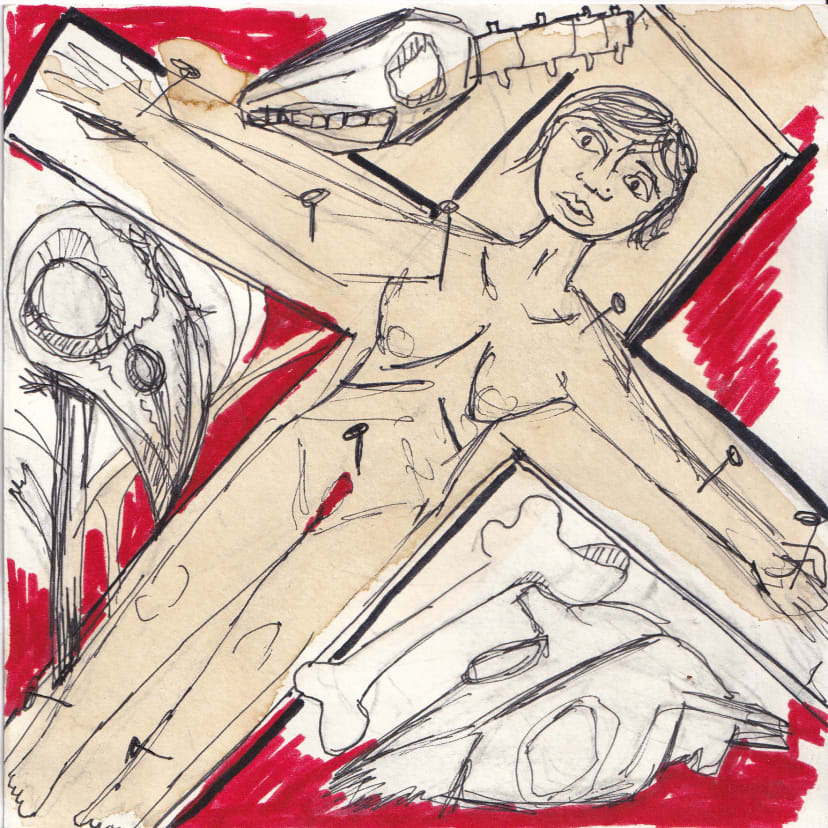
To grasp the significance of what she shows today, one must measure the path travelled. Her early canvases presented hybrid figures, unstable silhouettes, floating skulls. One might think of the classical vanitas; one would be wrong. In Sirin's work, the skull functions as what persists once the individual narrative has dissolved — a vestige, not a symbol. In her compositions on canvas, it hovers above seated bodies, solid yet fragmented, caught in flat fields of deep blue or vivid orange. The dissociation of head and body is not a formal exercise: it translates a condition. That of one who inhabits a space without being entirely present in it, or who carries a memory the present no longer knows how to receive. When she brings text and collage into the work, the gesture remains painterly. The 'Refused' stamp, the word 'visa', the inscription 'Comment sortir du monde' are not slogans. They are fragments lifted from the real, treated with the same economy as her silhouettes: layered, half covered over. One thinks of Bouchra Khalili and her cartographies of clandestine trajectories, but Sirin's gesture is more intimate, less systematic. It proceeds by accumulation of signs rather than by apparatus. Administrative violence appears as a background noise that runs through the painting without ever becoming its sole subject.
The cyanotypes on textile mark a turning point in this trajectory. The works leave the wall, hang in space, unfold vertically. In Blue Relic (2025), classical ruins and ancient architectures emerge in reserve within the blue, inhabited by spectral silhouettes. In Intimate Strata (2025), the fabric falls from the ceiling like a column of memory; a solitary figure floats among plant traces and accidents of light. The scale changes. So does the relation to the viewer: one no longer looks at an image, one moves through a territory. The fabric hangs, breathes, moves; its folds are a writing the artist only partly controls. There is in this formal letting-go something that echoes the work's very subject: accepting that memory is not an object to preserve but a process to move through.
This shift to textile places Sirin within a broader current of contemporary art — the one that, from Sheila Hicks to Ibrahim Mahama, makes fabric a political as much as a plastic material. But her specificity lies in what the cyanotype brings: a temporality. The Prussian blue that appears on her fabrics is not applied; it is the result of an exposure, in the photographic and existential sense of the word. Light inscribes, the fabric receives, time does the rest. Sirin does not fabricate images; she creates the conditions for images to occur. Her pieces carry within them a double exposure — to the sun of Tunisia and the light of France — and keep its mark the way skin keeps a burn.
What should be retained from this practice, beyond its formal coherence, is its position. Sirin Boubaker does not illustrate exile, does not testify to uprooting, does not perform the wounded identity — registers already well mapped and at times complacent in diaspora art. She does something else, something rarer: she gives form to that intermediate state, neither here nor there, where identity endlessly recomposes itself, and she does so with means that themselves partake of this instability. The fabric that hangs, the blue that varies with the light of day, the figure that appears and dissolves into the weave. Nothing is fixed. Everything is in progress. It is the very condition she describes, made visible.
Armature presents a solo show of Sirin Boubaker at Menart Fair Paris, 23-25 October 2026.