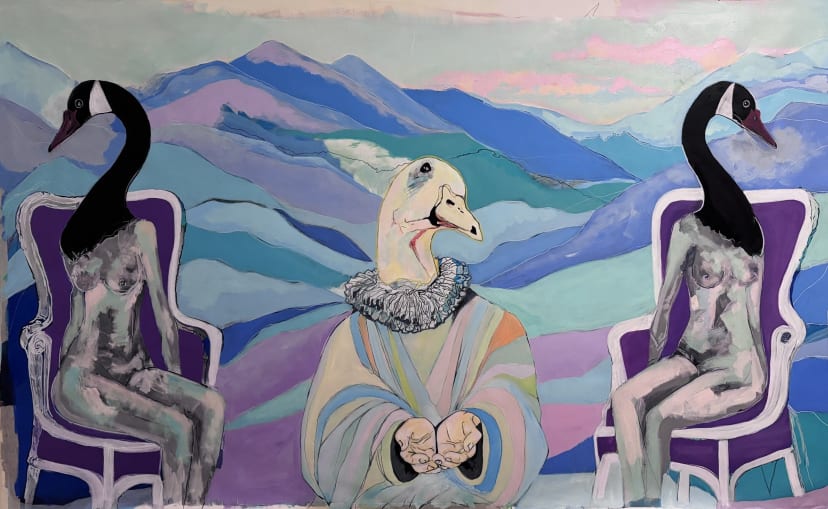
Drama
Sirin Boubaker2024-2026 · Mixed media on canvas · 95 x 155 cm
€4,200
Acquire on ArtsyMenart Fair Paris 2026
Sirin Boubaker
· Galerie Joseph-Turenne, 116 rue de Turenne, 75003 Paris · Booth R5 · Revealing section
From 23 to 25 October, Armature presents a solo booth by Sirin Boubaker at Menart Fair Paris, Revealing section, booth R5. Verdict brings together paintings made between 2024 and 2026 and never exhibited before, in which figures set in peaceful landscapes wear the heads of geese or black swans, or skulls, without anyone in the picture seeming surprised. Opening on Thursday 22 October, in the presence of the artist.
Book a meeting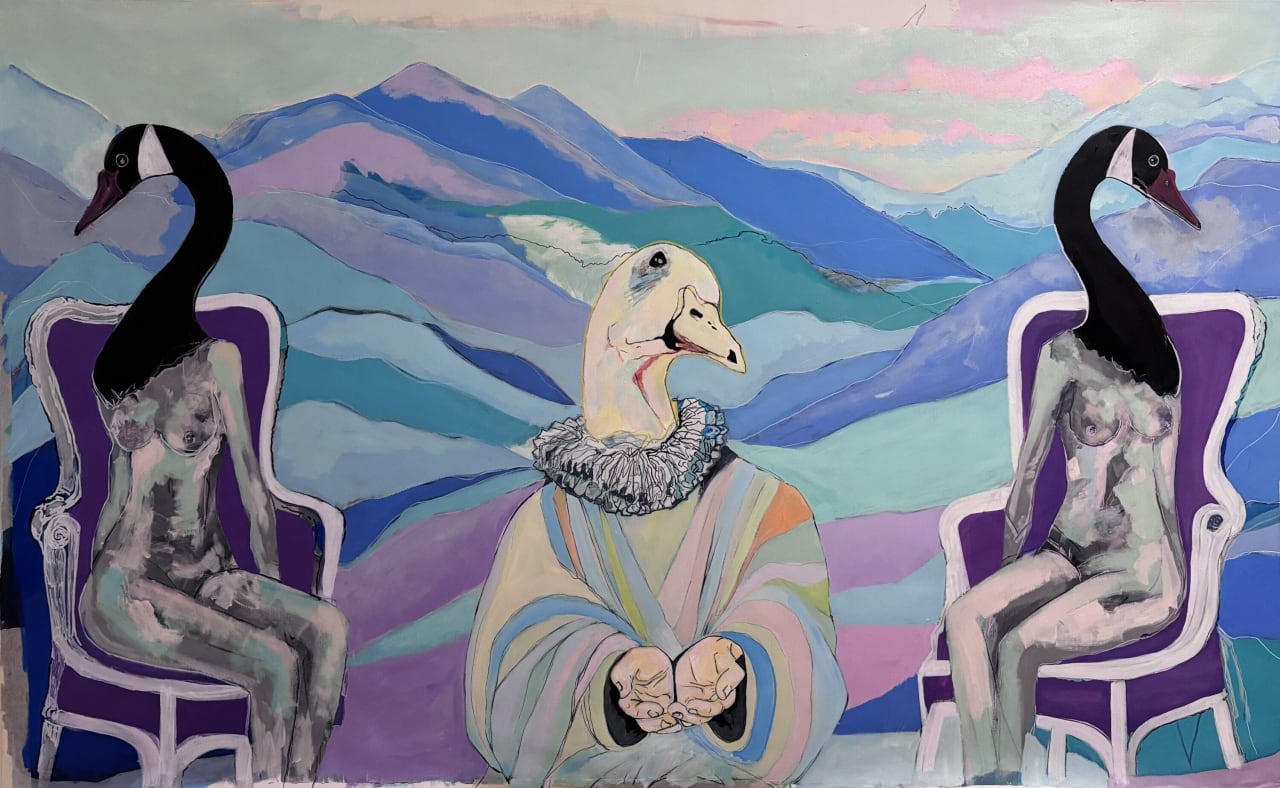
For its seventh edition, Menart Fair Paris puts a question to all its galleries, "Where is Home?", and Armature answers with Sirin Boubaker, born in 1993 in Kalaat el-Andalous, trained at the Fine Arts Institute in Nabeul, settled in Lyon after a spell in Paris, whose practice draws on painting as much as on collage, photomontage and cyanotype on textile.
One enters these paintings through colour, and the artist knows it, describing the trap herself: "you enter the image through something seductive, then you discover that something is wrong." The landscapes are made of bands of lavender, pink, pale green and sky blue laid down flat, the figures are outlined, and white drawing lines, left visible, recall that all of this is constructed. There is something here of Henri Rousseau and his Sleeping Gypsy, in which a lion sniffs at a sleeper under the moon while nothing in the smooth handling of the canvas betrays the slightest danger, for with Sirin Boubaker as with Rousseau, the threat is painted with the same calm as everything else.
Then come the heads, which the artist sets on naked or draped bodies in 2024, then on bodies in suits and ties or in hoodies in 2026, and the fable is claimed even as it is turned around: "In my paintings, the animals do not speak. They have replaced the humans." In Les Métamorphoses du jour, in 1829, Grandville was already crowning bodies dressed in the fashion of his day with the heads of beasts, and the 2026 paintings join him right down to the topicality of their clothes, whereas the nudes of 2024 moved the satire from costume to flesh, that of a female body Sirin Boubaker thinks of as "a territory: observed, judged, desired, regulated and controlled".
In Honor and Infamy, the 2024 diptych, the same draped figure, arms folded, set against a blue ground and then an orange one, takes up the pose of the ruffed court portrait, and in place of the face floats a skull, "an autonomous presence, detached from the body and suspended in space", the artist writes. Holbein hid death in anamorphosis at the feet of his Ambassadors, in 1533, for those who knew how to change their point of view. Here it has taken the sitter's place, and from one canvas to the other nothing moves but the colour of the ground and the title, which alone decides on which side of history the portrait falls.
Drama gives the presentation's title its meaning. At the centre, a goose-headed figure in a ruff and striped drapery holds out empty, cupped hands, between two nudes with black birds' heads seated in ceremonial armchairs, in the frontal arrangement of a presiding judge between his assessors, before a range of blue mountains where nothing happens. Something has been pronounced, no one knows when or by whom, and those who delivered it, or suffered it, wait, armed with what the artist calls "our capacity to get used to anything".
The 2026 paintings turn this waiting into a conversation. A skull and a black swan face each other on two yellow chairs in Dis, tu te souviens ? (Say, do you remember?), then lie side by side, hands behind their heads, in Et si nous restions encore un peu ? (What if we stayed a little longer?), while in Dis, quand reviendras-tu ?, which bears the title of a 1962 song by Barbara, a goose-headed dignitary waits in his gilded armchair as two swan-women fly away above him.
The fair's question finds its most direct answer in How To Leave The World, painted in 2025, where the painting comes apart in orange and black masses scored with pencil: a "REFUSÉ" stamp is printed in red over a French visa stamp, and the skull-and-ruff figure of Honor reappears at the edge, next to a question written in black letters, comment sortir du monde, how to leave the world. And if these paintings set out from a Tunisia left behind and a France lived in, they look well beyond that journey, towards beings who have, in the artist's words, "simply stopped pretending to be entirely human", and who ask those who look at them for neither pity nor indignation, only that they recognise, in that calm, their own.
Sirin Boubaker, Verdict, Menart Fair Paris 2026, Galerie Joseph-Turenne, 116 rue de Turenne, 75003 Paris, Revealing section, booth R5, 23 to 25 October 2026, opening on 22 October.
Open to the public on Friday 23 and Saturday 24 October from 12 pm to 8 pm, and on Sunday 25 from 12 pm to 7 pm, with last entry thirty minutes before closing and VIP early access from 11 am to 12 pm. On Thursday 22 October, preview for collectors, institutions and press from 3 pm to 6 pm, then opening by invitation from 6 pm to 10 pm.
On the booth, three paintings hang at a time and are rotated from storage. The full series and its prices are on this page.
2024-2026 · Mixed media on canvas · 95 x 155 cm
€4,200
Acquire on Artsy
2025-2026 · Mixed media on canvas · 100 x 185 cm
€6,000
Acquire on Artsy
2024-2026 · Mixed media on canvas · 100 x 150 cm
€4,200
Acquire on Artsy
2024-2026 · Mixed media on canvas · 85 x 100 cm
€2,800
Acquire on Artsy
2024-2026 · Mixed media on canvas · 85 x 100 cm
€2,800
Acquire on Artsy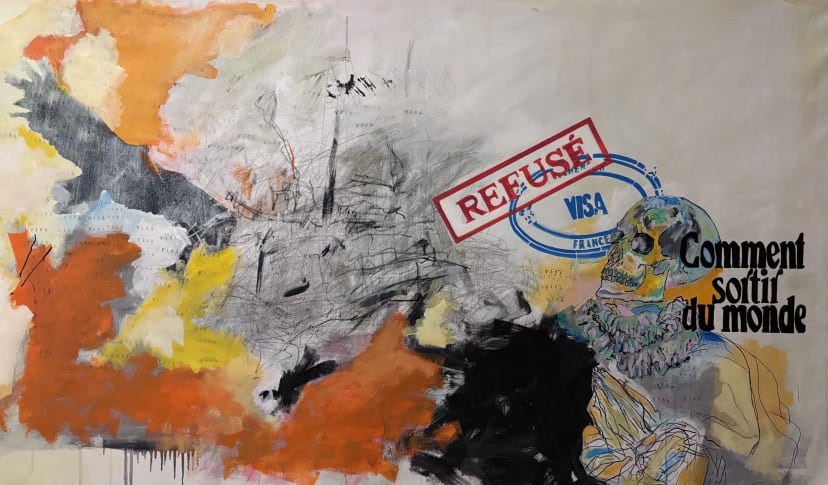
2025-2026 · Mixed media on canvas · 80 x 165 cm
€4,000
Acquire on Artsy
2024-2026 · Acrylic on canvas · 80 x 150 cm
€3,800
Acquire on Artsy
2026 · Acrylic on canvas · 120 x 80 cm
€3,200
Acquire on Artsy
2026 · Acrylic on canvas · 120 x 80 cm
€3,200
Acquire on Artsy
2026 · Acrylic on canvas · 120 x 90 cm
€3,400
Acquire on Artsy