Ce qui resteLire ce guide en françaisSee the map : Lift lobby

OFF programme, 16th Dakar Biennale

Ce qui reste

. Sama Hotel, Asaman Rooftop (ninth floor), route des Almadies, Dakar.

No shock is ever transformed entirely: a part of it remains, lodged in bodies and in memories, that neither strength nor repair absorbs. This is the part the exhibition looks at, through marks that surfaced elsewhere and after the shock that made them.

4 works

Lift lobby

Lilia El Golli, Blooming Day, 2021

Artwork no. 1 : Blooming Day, 2021

Fine art print on Hahnemühle Photo Rag® Metallic 340 gsm cotton paper

  • 60 × 40 cm€2,250approx. 1,476,000 FCFA
  • 120 × 80 cm€4,450approx. 2,919,000 FCFA
Write to Armature (new tab)View on Artsy (new tab)

Lilia El Golli, a French-Tunisian photographer born in 1972, who has lived in Paris, Madrid and Dublin and works from her studio near Paris with long stays in Tunisia, builds scenes by hand, photographs them in the studio and then takes them apart, so that each image is what is left of a sculpture that no longer exists. Her 2021 series Broken Egg(0) revolves around a single motif, the egg, always broken, always gilded, and counted from zero as the title says, a title that can also be heard as a broken ego. It was born of an intimate ordeal, that of a childless couple in which suspicion falls at once on the woman, as if it went without saying, when the cause lay elsewhere, and the images came afterwards, with titles that name what was attributed to her. Facing the lifts, Blooming Day opens the visit on a break that has already happened: on a pink ground, a bare tree planted in a glass jar whose lid has been left open bears golden eggs on its branches, some intact, others open like flowers, while a few broken shells lie at the bottom of the jar. The egg is one of the oldest symbols of origin, the one Piero della Francesca hung above the Virgin in the Brera Altarpiece, and Lilia El Golli makes it bloom in a jar, the vessel in which things are preserved, like a flowering kept under glass for want of seeing it come. The visitor may think of kintsugi, the Japanese art of mending ceramics with gold lacquer, and the gap is telling. For here the gold covers the whole shell, crack included, without mending anything, so that the breakage becomes the very substance of the flowering.

The artist

Lilia El Golli (born in 1972) is a French-Tunisian photographer and author. She lived and studied in Paris, Madrid and Dublin, and now works from her studio near Paris, with long stays in Tunisia that feed her work. Her photography, minimalist and close to surrealism, explores the "unseen", what surrounds us without catching the eye, and questions our relationship to the land, the condition of women and the gap between what is imagined and what is pictured. Shadow, light, colour and movement trace an inner journey at the edge of the mystical. Her series Broken Egg(0) (2021), from which Blooming Day and Leviathan's Glory are taken, makes the egg a motif of fertility, identity and creative resilience, linking Tunisian childhood memories to the transformation of an intimate ordeal into a new form. Her fine art prints on Hahnemühle paper are issued in limited, numbered and certified editions. Honourable mention at the Africa Photo Awards (2020) and winner of a Pro d'Or Havas (2013), she has exhibited in Paris, Tunis, Arles, Geneva and Saudi Arabia, and has collaborated with Arte, Carnet d'Art and BabelMed.
View Lilia El Golli’s page

Lilia El Golli, Leviathan's Glory, 2021

Artwork no. 2 : Leviathan's Glory, 2021

Fine art print on Hahnemühle Photo Rag® Metallic 340 gsm cotton paper

  • 60 × 90 cm€3,450approx. 2,263,000 FCFA
  • 80 × 120 cm€4,450approx. 2,919,000 FCFA
Write to Armature (new tab)View on Artsy (new tab)

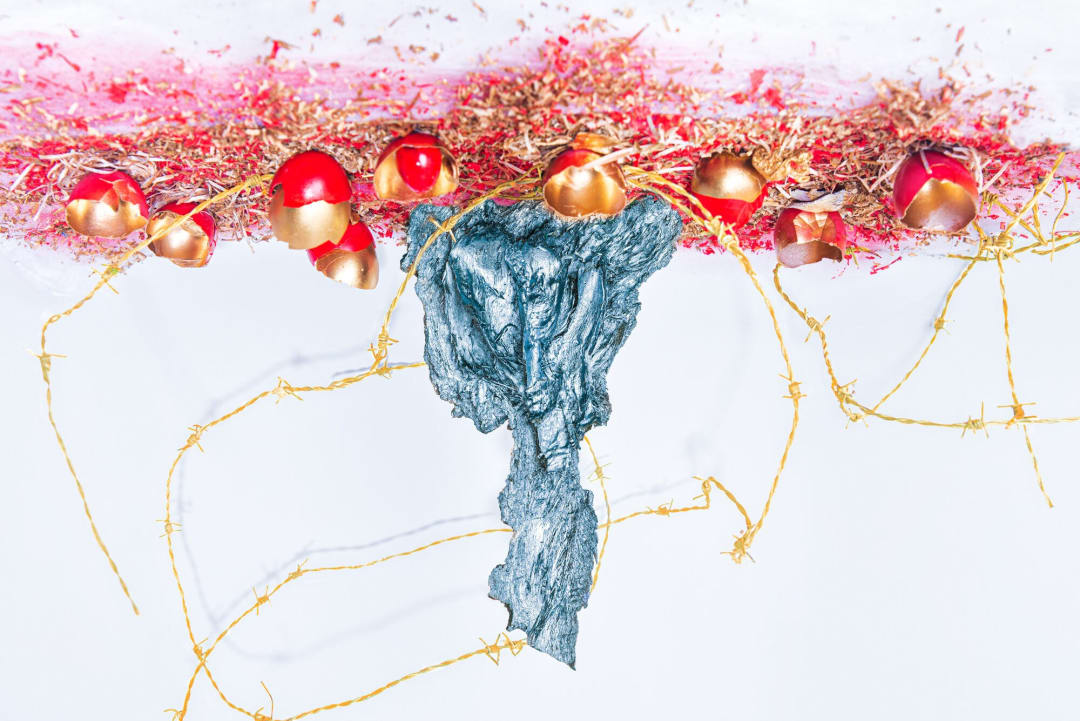
In Leviathan's Glory, a band of pink and red straw runs across the top of the image, eggs of gold and red lacquer surface in it like buds, a heavy blue-grey bark in the shape of a V drops below, and gilded barbed wire loops across the pale ground. The title summons the Leviathan, the sea monster of the Book of Job, which Thomas Hobbes made in 1651 the figure of the State, that immense body composed of all the subjects who have handed it their strength. The glory of the Leviathan is here the common order that assigns each person a function, and women first of all the function of bearing children, and Lilia El Golli gives it the barest form of constraint, barbed wire, which she has gilded as one gilds an ornament, to the point that it merges with the eggs it encloses. The viewer remains caught in this ambiguity, since the same gold designates what is born and what holds back, and nothing in the image says whether the wire protects the eggs or keeps them captive. At the centre, the bark, the only material left in its own colour, hangs like a skin torn from a tree we cannot see, which gives this almost decorative composition the weight of a wounded thing.

Lilia El Golli, Talking Heads, 2021

Artwork no. 3 : Talking Heads, 2021

Fine art print on Hahnemühle Photo Rag® Metallic 340 gsm cotton paper

  • 60 × 90 cm€3,450approx. 2,263,000 FCFA
  • 70 × 100 cm€3,850approx. 2,525,000 FCFA
Write to Armature (new tab)View on Artsy (new tab)

Talking Heads sets on a white ground, with neither shadow nor floor, a bare gilded tree bearing glossy black eggs at the tips of its branches, with at its foot a crown of broken shells and ashes among which five headless lead figurines are scattered, each with an arm raised and armed. In English, talking heads are the faces of television panels and, more broadly, of all those who comment, and in a series born of a suspicion they designate those who speak in place of others and decide where the fault lies. Yet Lilia El Golli's soldiers have lost their heads, and the only heads in the image are these black eggs, mute, hanging from the tree like burnt fruit. The lead figurine comes from childhood, from the toy one lines up on a rug to replay battles, and the armed arm, repeated five times, turns the scene into a little nursery war to which the ashes give an air of the morning after. The golden tree, which might have come out of a fairy tale, thus bears black fruit above a miniature battlefield, so that the brilliance of the staging slowly reveals, to whoever looks at it, what has burnt.

Lilia El Golli, Broken Pelvis, 2021

Artwork no. 4 : Broken Pelvis, 2021

Fine art print on Hahnemühle Photo Rag® Metallic 340 gsm cotton paper

  • 60 × 40 cm€2,250approx. 1,476,000 FCFA
  • 100 × 70 cm€3,850approx. 2,525,000 FCFA
Write to Armature (new tab)View on Artsy (new tab)

Broken Pelvis sets up, on a light wooden table, a silver stemmed glass with a gilded neck in which gilded eggshells are stacked one on top of another like vertebrae, the highest one open and pierced by light, against a white ground so overexposed that the whole thing stands as if erect. One thinks of The Broken Column, which Frida Kahlo painted in 1944, opening her own torso onto a split Ionic column, she whose pelvis, crushed in a bus accident when she was eighteen, kept her from carrying a pregnancy to term. Lilia El Golli's title names the same wound, the one attributed at once to the woman's body when a couple has no child. Yet the image shows no woman's body, only this column of empty shells, raised in its silver flute, which points, with discreet irony, to the other side of the couple, where the cause lay.

18 works

Lounge and bar

Sonia Ben Slimane Besada, Espoir sous la mer, 2023

Artwork no. 5 : Espoir sous la mer, 2023

Acrylic and ink on canvas · 90 × 65 cm

€1,500approx. 984,000 FCFA

Write to Armature (new tab)View on Artsy (new tab)

Sonia Ben Slimane Besada, born in Tunis in 1996, a Tunisian-Spanish artist based in Copenhagen, trained at the Atelier de Sèvres, the École nationale supérieure d'art de Limoges and then the Københavns Kunstskole, paints a bestiary of bulls, foxes, flying fish and lemon-moons that draws as much on tales as on the oldest images of all, those of painted caves. Espoir sous la mer (Hope beneath the sea), in its white painted frame, edges a field of cobalt with a frieze of small coloured signs, suns, spirals, arrows and waves, as one borders a hanging or the margin of a manuscript. At the top left a black bird carries a green branch, a trail of white signs rises from a red block towards an ochre one, and on the right a dark figure tumbles above a lemon. The title and the bird bring back the story of the Flood, in which Noah first releases a raven, which does not return, then a dove, which brings back an olive leaf, a sign that the waters are receding. Yet Sonia Ben Slimane Besada gives the branch to the black bird, the one that in Genesis brings back nothing, as if hope returned through the messenger from whom no news was expected any longer. Beneath this blue that covers everything, the signs of the border look like a writing from before writing, the only one that could still say something of a drowned world.

The artist

Sonia Ben Slimane Besada (born in 1996 in Tunis) is a Tunisian-Spanish visual artist based in Copenhagen. Trained at the Atelier de Sèvres, the École nationale supérieure d'art de Limoges and then the Københavns Kunstskole, she works in painting, ceramics and sculpture. Her compositions draw on tales, poetry and the oldest of images, from the cave paintings of Altamira and Charama to the hangings of East Asia. Out of them comes a bestiary of bulls, foxes, flying fish and lemon moons, somewhere between magical realism and childhood memory. Her work has been shown in Tunis in the exhibition Musk & Amber (2025) and at Archivart Gallery with "Cette part de vestiges en moi…" (2026).

View Sonia Ben Slimane Besada’s page

Sonia Ben Slimane Besada, Plongée dans l'océan cobalt, 2021

Artwork no. 6 : Plongée dans l'océan cobalt, 2021

Acrylic and ink on canvas · 90 × 70 cm

€1,500approx. 984,000 FCFA

Write to Armature (new tab)View on Artsy (new tab)

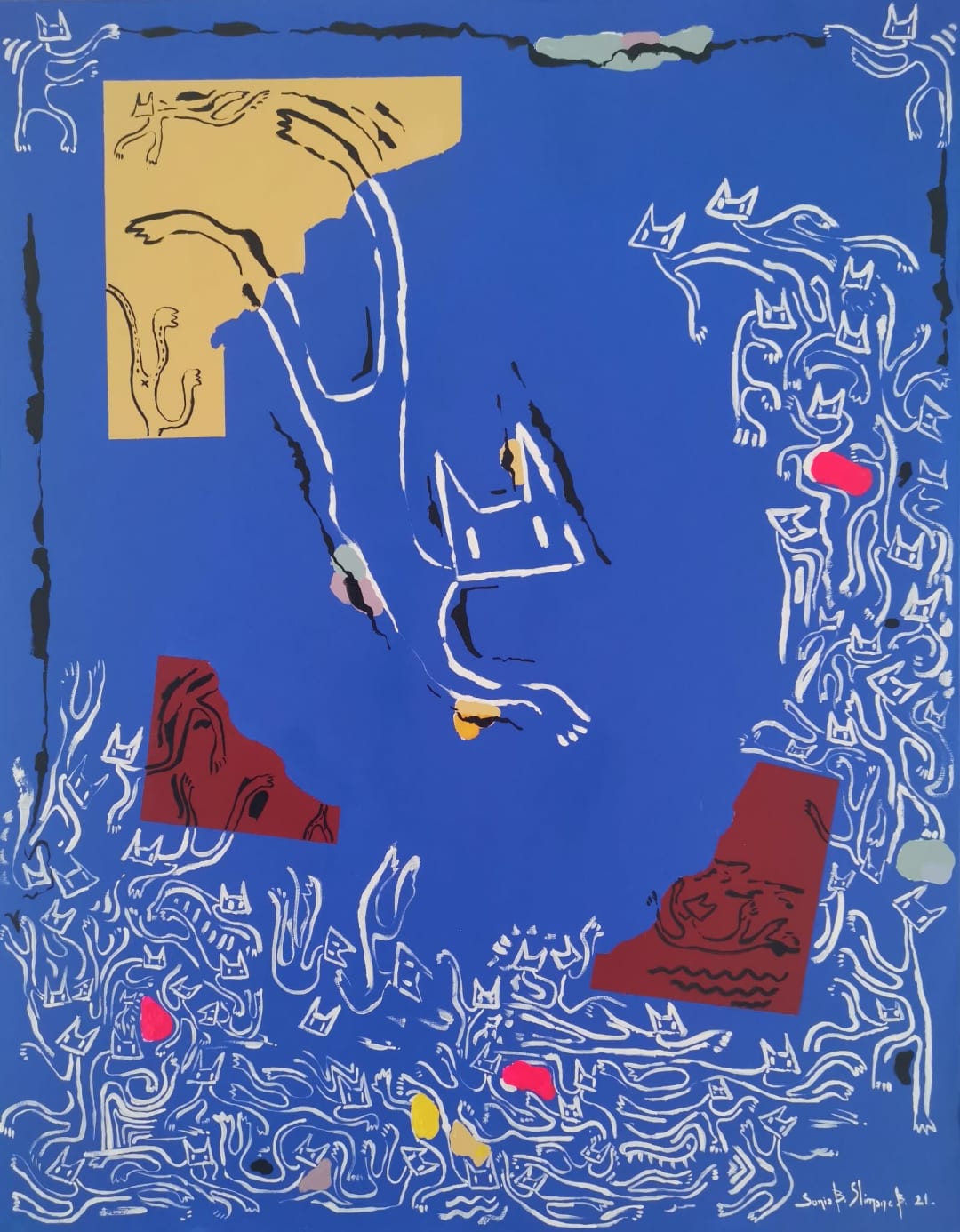
Two years earlier, Plongée dans l'océan cobalt (Dive into the cobalt ocean) already laid down this deep blue. A creature with cat's ears, drawn in a single white line, dives from an ochre block at the top left towards two dark red blocks that look like fragments of walls, while swarms of small creatures, traced with the same line, crowd the right edge and the bottom of the canvas, dotted with touches of pink and yellow. This continuous line, laid down without second thoughts, recalls the cave drawing the artist names among her sources, from Altamira to the caves of Charama, and the white on blue gives the animals the lightness of an apparition. The cat, which avoids water, is here the one that dives, which is enough to tip the scene into the magical realism of tales, where animals do what their nature forbids them. And the red blocks, set at the bottom like the remains of a building, announce the exhibition the artist titled in 2026, at the Archivart gallery, « Cette part de vestiges en moi… » (This part of ruins in me). The dive then becomes a descent towards what endures of a place, beneath a sea that keeps ruins more surely than it erases them.

Ymen Berhouma, The Happy Few, 2024-2025

Artwork no. 7 : The Happy Few, 2024-2025

Watercolour and acrylic on Canson paper · 77.5 × 148 cm

€7,500approx. 4,920,000 FCFA

Write to Armature (new tab)View on Artsy (new tab)

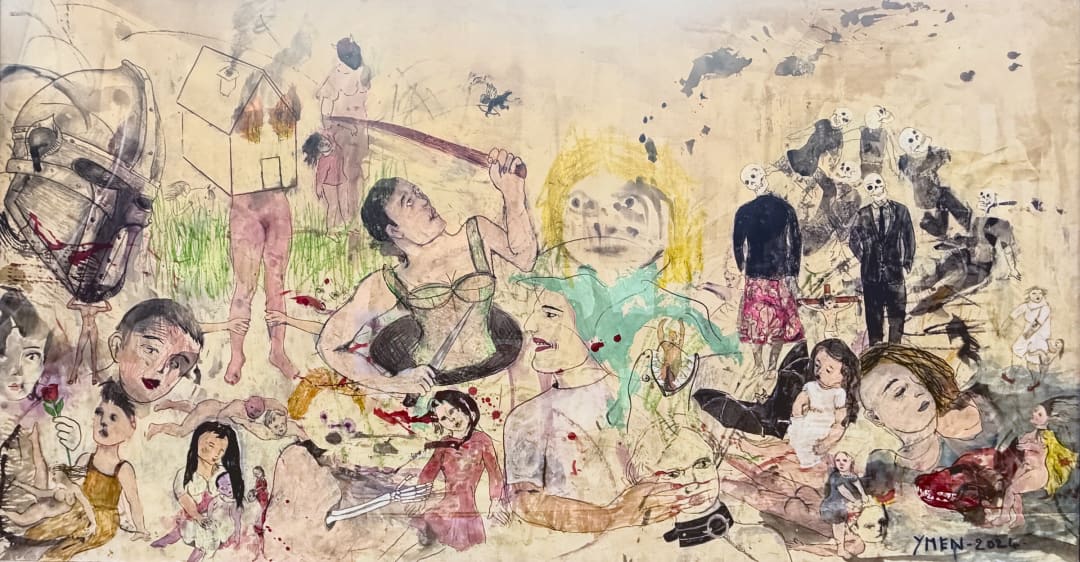
Ymen Berhouma, born in Tunis in 1976, self-taught, has been painting and drawing for twenty years, moved from painting to drawing on paper and founded Atelier Ymen in Tunis, a collective that shows young artists. The Happy Few is a frieze almost a metre and a half long, in watercolour and acrylic on paper, filled from edge to edge, in which moments follow one another without forming a story: a small naked body holds out a bleeding helmet at arm's length, a house burns, standing on two legs, a woman in a corset pulls on a red strap, children, dolls, sleepers and pencilled faces float everywhere, and on the right a procession of skulls in black suits advances. It is the only work in the visit where the visitor sees the blow itself, while the others show its mark. The title comes from Shakespeare, from the speech King Henry V gives his soldiers before Agincourt, in 1415, we few, we happy few, where he names those who choose to fight with him, and Stendhal made it the dedication of his novels, to the happy few, so much so that in French the phrase designates the privileged. For Ymen Berhouma, the happy few are the courageous, those who suffer violence and hold on. Yet before this procession in black suits, the title takes on a dark irony, in the line of the danses macabres painted in the fifteenth century along cemetery walls, in Paris at the Holy Innocents, and of James Ensor's processions of masks, where the crowd parades grimacing. Here the dead wear the suits of the powerful, as if death now advanced in their guise. Still, the sheet is beautiful, with a fine line and tender colours borrowed from children's books. And that is the whole paradox of this work, which finds beauty in the violence it shows. For this gentleness holds the gaze long enough for it to reach the end of the procession.

Karima Ben Cheikh, La salle de bain, 2024

Artwork no. 8 : La salle de bain, 2024

Oil on canvas · 100 × 80 cm

€3,900approx. 2,558,000 FCFA

Write to Armature (new tab)View on Artsy (new tab)

Karima Ben Cheikh, born in Tunis in 1986 and based in Paris since 2010, where she studied art at the Sorbonne, went through graphic design, watercolour and the graphic novel before taking up oil painting in 2022, and her painting keeps returning to memory, to the way of finding rooms and scenes from the past and reconstructing them in a phantasmagorical manner. La salle de bain (The bathroom) is painted at night and in a single colour, a monochrome of blues ranging from almost white to almost black. In the foreground runs the striped edge of a bed, then the floor tilts towards the viewer, with in the middle a pair of slippers on the rug, a washbasin under a mirror, a toilet with its lid raised, a washing machine, bottles on a shelf and, on the wall, a picture of a moon rising over mountains. In the history of painting, the bathroom is the room of the nude, the one where Degas caught women at their toilette and where Bonnard painted Marthe in her bath for nearly twenty years. Karima Ben Cheikh removes the body, of which only the slippers remain, set down as if someone had just walked out of the room. The tilting perspective and the moon reduced to a picture, in a room whose window stays black, point to a place recomposed by memory rather than seen, where every object has found its place again, except the person. For remembering a room means recomposing it, object by object, in a light that memory invents.

The artist

Karima Ben Cheikh (b. 1986, Tunis) is a Tunisian multidisciplinary artist who has lived and worked in Paris since 2010, where she studied art at the Sorbonne. After working in graphic design, she devoted herself entirely to art in 2021, first through watercolour, graphic novels, children's books, music, video and photography, before turning to oil painting in 2022. Her painting, expressionist and moving between figuration and abstraction, returns to two subjects: solitude, which she paints as a condition for creating, and time, which she holds to be a continuous present, so much so that she often paints new works over existing canvases. She held a solo show of thirty-four works at the Danube Palace in Paris in 2022 and has taken part in group exhibitions in Paris, among them Plurielles 2 (2022) and Agora (2023), as well as Nice Art Expo, and she was a finalist in the See.Me New Realism competition in 2023, after an honourable mention in its Evolve competition in 2022. She is a co-founder of Galerie KHÅL in Paris.

View Karima Ben Cheikh’s page

Karima Ben Cheikh, La salle à manger, 2024

Artwork no. 9 : La salle à manger, 2024

Oil on canvas · 50 × 50 cm

€2,200approx. 1,443,000 FCFA

Write to Armature (new tab)View on Artsy (new tab)

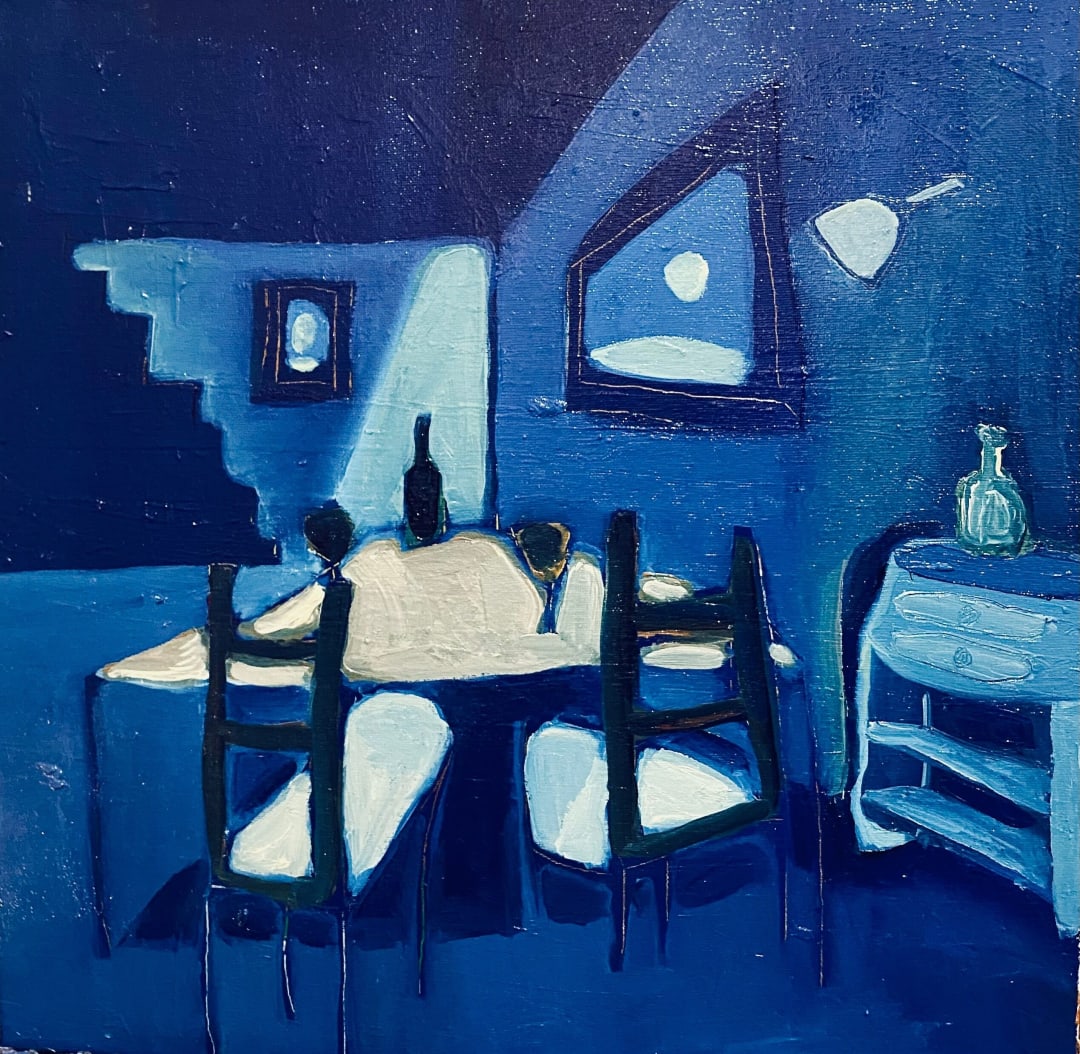
La salle à manger (The dining room), smaller and square, extends the same blue night. Two empty chairs stand before a table laden with a white cloth and a dark bottle, a carafe waits on the sideboard, a lamp hangs from the ceiling, and on the wall a small frame holds a pale oval while a larger one holds a moon, as in La salle de bain, so that the two rooms seem to belong to a single house of which memory would return only fragments. The light falls on the wall in a stepped patch, the trace of a staircase we do not see, and one thinks of Edward Hopper, who painted in 1963, in Sun in an Empty Room, a room where nothing remains but the sun on the walls. Karima Ben Cheikh keeps from Hopper this light that takes the place of the figures, but she plunges it into night and into blue, which strips the scene of any precise hour or place. She often paints her new canvases over existing ones, covering without erasing, as one lives several times in the same room. Nothing says whether the meal is over or has not yet begun, since memory has kept the chairs and the cloth and has lost the guests.

Zitch, Comfortably Numb, 2026

Artwork no. 10 : Comfortably Numb, 2026

Acrylic on canvas · 100 × 75 cm

€2,800approx. 1,837,000 FCFA

Write to Armature (new tab)View on Artsy (new tab)

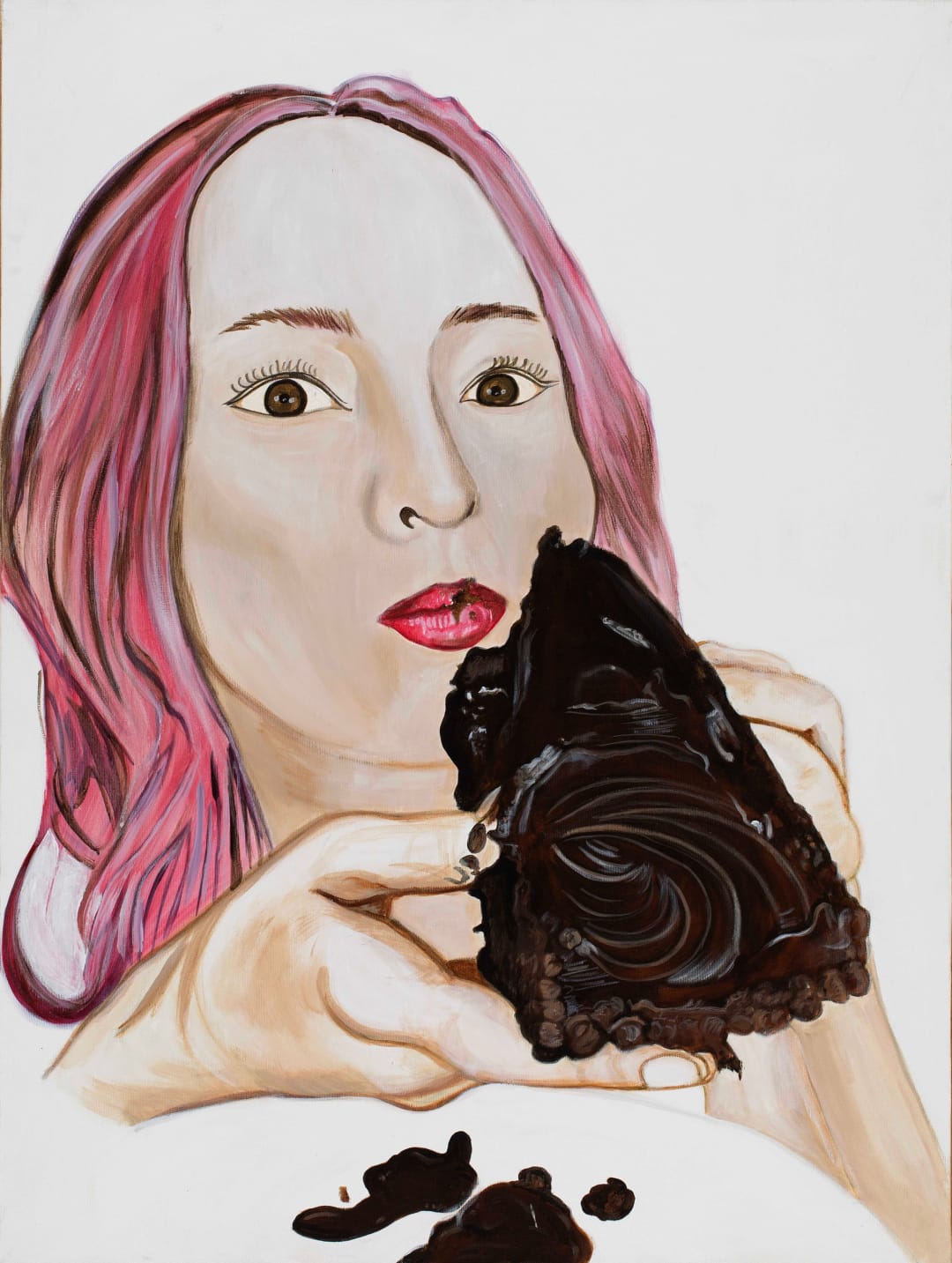
Zitch, a Tunisian painter trained at the Institut supérieur des beaux-arts de Tunis after studying economics and political science in Tunis and Lisbon, first painted the repetitive scenes of everyday life, then returned to drawing in 2021 to take on the patriarchal model, with the eighty-two small uncensored drawings of Feeling the Gap, before moving on, with her ongoing body of work Overflow, to appetite and abundance. Comfortably Numb shows, from the front, a young woman with pink hair raising a slice of chocolate cake to her mouth, her eyes wide open, a crumb on her red lips and dark smears on the white surface below. The eater who looks back at the viewer has a founding picture, The Bean Eater, painted by Annibale Carracci around 1585, in which a peasant pauses, spoon raised, to stare at the one watching him eat. In Zitch's painting the gesture is the same and the hunger has gone, since the young woman eats with the fixed gaze of someone who no longer tastes what she swallows. The title, borrowed from the Pink Floyd song, names this state, less a pain than a numbness, that of a pleasure serving as anaesthesia while the world burns. The painting, frontal like an advertising image, makes the scene appetising to the point of unease. Only the crumb at the corner of the lips and the dark smears on the white betray the excess.

The artist

Zitch is a Tunisian artist who works between painting and drawing, based in Tunis. She trained at the Institut Supérieur des Beaux-Arts de Tunis, where she took a Bachelor in Fine Arts with a painting speciality in 2022 and a research master's degree in 2024, after studies in economics and political science in Tunis and Lisbon. She began painting in 2019, with large canvases given over to ordinary and repetitive scenes, and returned in 2021 to drawing, the medium of her adolescence, to take on the patriarchal model and the conformity it produces. Feeling the Gap (2021), eighty-two small black and white drawings of scenes of sexual life shown without censorship, made the viewer's own reaction a material of the work. Her research then moved to the place women hold in public space, and to the poster as a way of occupying it. Overflow, her current body of work, turns to appetite and industrial abundance: crisps, sweets and packaging painted at close range, food leaving the image to enter the room.

View Zitch’s page

Zitch, Glouton social, 2025-2026

Artwork no. 11 : Glouton social, 2025-2026

Acrylic on canvas · 75 × 100 cm

€3,200approx. 2,099,000 FCFA

Write to Armature (new tab)View on Artsy (new tab)

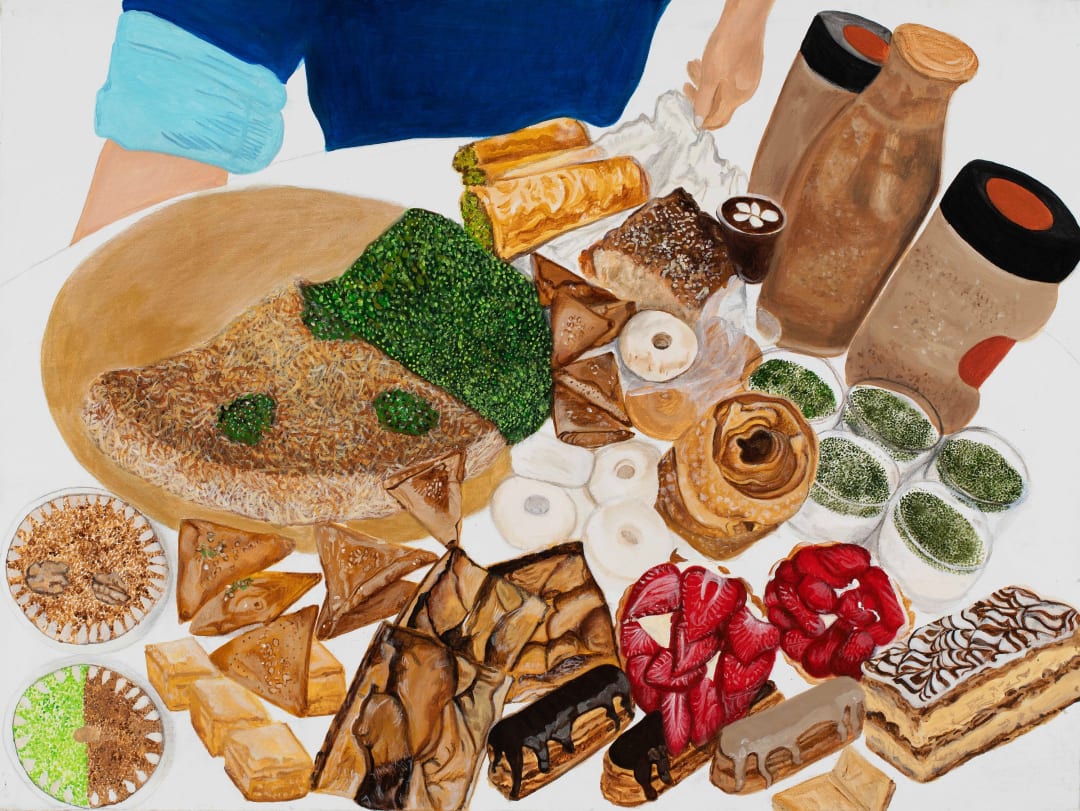
Glouton social (Social glutton), which answers Comfortably Numb, shows the table. Seen from above, on a white cloth, the sweets pile up, a tray of kunafa crowned with pistachio, baklawa rolls, pastry triangles, sugared rings, strawberry tartlets, éclairs, a mille-feuille with marbled icing, cups of pistachio cream and jars of spread, while a figure in a blue top stands at the edge and a hand reaches into the paper wrapping. The painted cake has its master, Wayne Thiebaud, who in the 1960s lined up slices of pie and display-case pastries under shop lighting. Zitch takes up their greedy frontality and moves it from the shop window to the Tunisian festive table, where sugar circulates at every celebration and what one serves says what place one holds. She also plays with perspective, so that the familiar table seems slightly off balance and the food spills over every edge of the canvas, as if it were trying to enter the room. A still life of our time, synthetic and chemical, the canvas holds a tension, since the surfeit sickens and the painting seduces all the same. The title refers to the sin of gluttony, which Hieronymus Bosch painted around 1500 on his Table of the Seven Deadly Sins in the guise of a man at table devouring his food. Zitch turns it into a collective vice, that of a society where everything is abundant and nothing is ever enough, where one eats and buys to fashion an identity. Her painting thus joins the critique of consumption carried out by Arman's accumulations and César's compressions, at a time when consumption reaches desire itself.

Sirin Boubaker, Shattered Abyss, 2025

Artwork no. 12 : Shattered Abyss, 2025

Cyanotype on antique linen, red silk thread embroidery, machine stitching · 98 × 36 cm

€1,200approx. 787,000 FCFA

Write to Armature (new tab)View on Artsy (new tab)

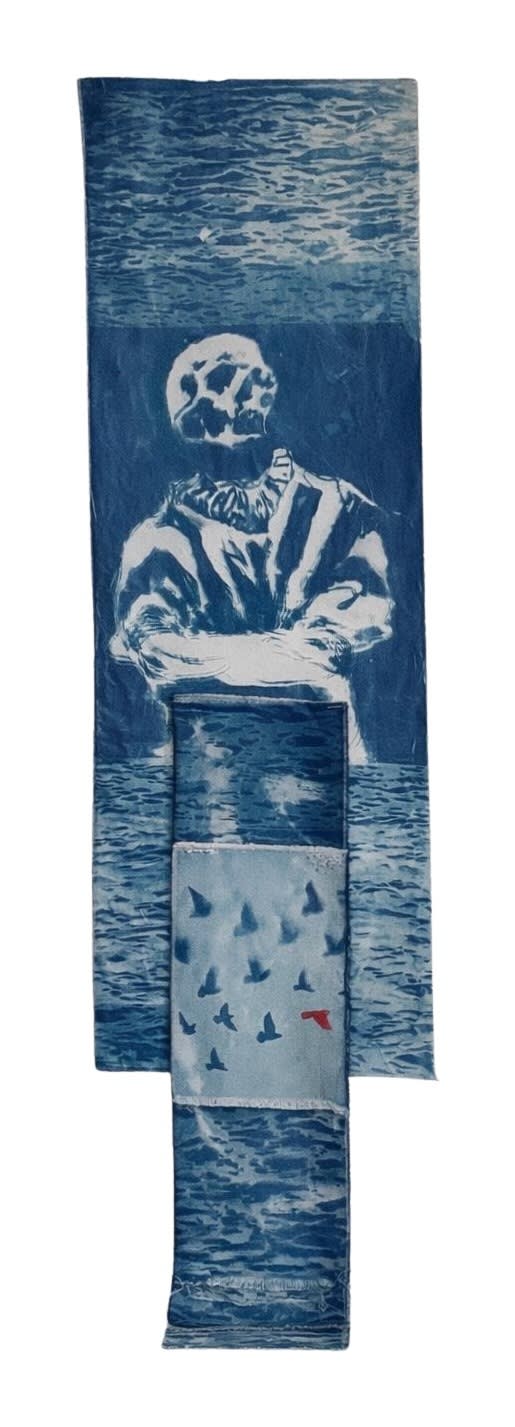
Sirin Boubaker, born in 1993 in Kalaat el-Andalous, Tunisia, a graduate of the Beaux-Arts in Nabeul and based in Lyon, combines painting, collage and cyanotype on fabric, and peoples her images with hybrid figures, skulls and black swans. Shattered Abyss, hung on the pillar, is made of two sewn elements. On a strip of antique linen covered with sea stands a bust in a ruff, arms folded, with a skull in place of the head, reserved in white like a negative, and over it a second element, machine-stitched, cuts the bust at the waist and falls lower than the first, with sea and a pale square crossed by a flock of small dark birds, only one of which is embroidered in red silk. The figure comes from a diptych painted in 2024, Honor and Infamy, and its ruff is the collar of the notables of the time when Dutch painting set skulls on tables to remind the living that they will die, what is called a vanitas. Here the skull has left the table to take the place of the face, and it folds its arms like someone waiting. The cyanotype, a process invented in 1842, needs no brush, since the fabric turns blue where light touches it and stays white where something has hidden it. This vanitas is therefore a shadow. Only the red bird escapes the light, the artist having embroidered it by hand in silk thread, so that the eye, after travelling down the whole strip, comes to rest on it as on the only living thing in this shattered abyss.

The artist

Sirin Boubaker (born in 1993 in Tunisia) is a painter and visual artist. Her practice combines painting, collage, photomontage and cyanotype on fabric, and questions memory, human fragility and what time leaves behind in our inner landscapes. Her canvases are peopled with hybrid figures, skulls and the recurring motif of the black swan, messenger of the unforeseeable. She holds a master's degree in theory of creation (Institut Supérieur des Beaux-Arts de Nabeul, 2017) and has exhibited at the Institut français de Tunisie, TGM Gallery, the National Library of Tunisia and Galerie Khal in Paris, among others. She lives and works between Tunisia and France.

View Sirin Boubaker’s page

Jared Aufrichtig and Ryan Shava, Human Resources, 2021-2024

Artwork no. 13 : Human Resources, 2021-2024

Mixed media · 45.5 × 35.5 × 3 cm

€1,400approx. 918,000 FCFA

Write to Armature (new tab)View on Artsy (new tab)

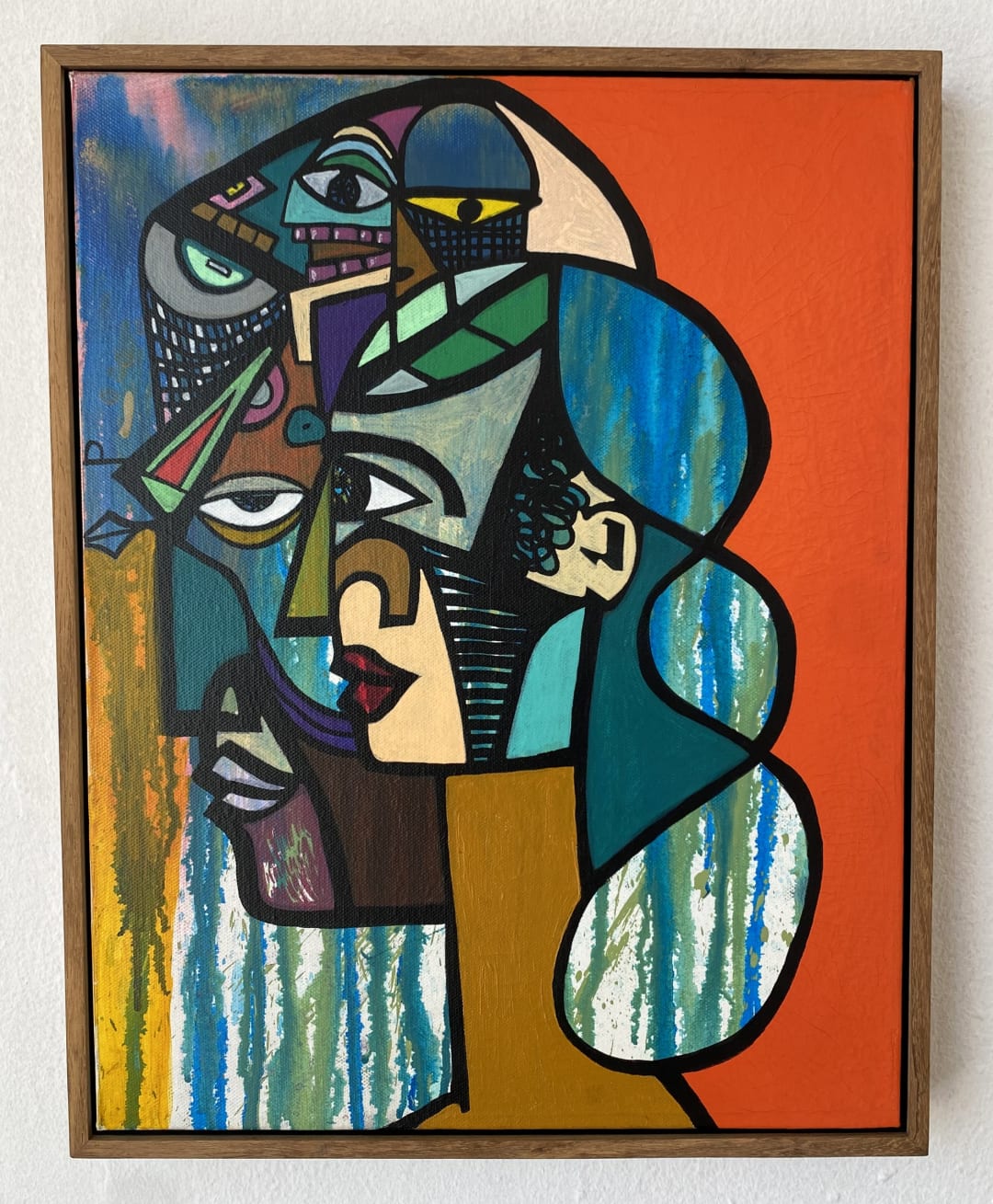
Jared Aufrichtig, born in 1981 in Long Beach, California, lives and works in Cape Town, where he came to painting from graffiti and murals, and his practice moves between painting, printmaking, film photography and street art. For five years he has painted with Ryan Shava, South African, born in 2000, on walls as on canvases they sign together. Human Resources, a small canvas painted by four hands between 2021 and 2024 and then animated into a unique digital piece, which the screen shows swept by a light, gathers several faces into a single head, made of blue and ochre facets on an orange ground, with mouths that are not the same and skins none of which shares the colour of its neighbour. Since Picasso, painting has known how to show a face from the front and in profile at once. The two artists do the opposite by housing several people under a single skull, which, in South Africa, where after 1994 people spoke of a rainbow nation to describe colours living side by side within one country, brings that image of the collective down to the scale of a single person. On the back, in their own hand, they wrote male, female, ego, id, inside, outside, and everything in between, comparing this abundance of feelings to the minerals the earth keeps within it. Yet the title borrows the language of business, which counts people among resources, in a country whose wealth came out of its mines, which gives the comparison with minerals quite another weight. The portrait, held together only by the sutures between its facets, makes the human resource what a being keeps in reserve and what no one can extract.

The artist

Jared Aufrichtig is a South African artist, born in Long Beach, California, who lives and works in Cape Town. His practice moves between painting, printmaking, film photography and street art, with a process-led approach in which each work grows out of an experience and carries its own story. Text, collage and a pop vocabulary meet a free, almost calligraphic line and an expressionist sense of colour. Engagement runs through his work, from the question of water as a resource to the many faces a single person can wear, as in the painting Samurai Farai Three Wisemen (2021) and the Mirror Man series. Coming from graffiti and murals, he has extended his work to prints and digital editions. His work has been the subject of a text by the critic Ashraf Jamal in the South African Art Times.

View Jared Aufrichtig’s page

Sirin Boubaker, Dustfall, 2025

Artwork no. 14 : Dustfall, 2025

Cyanotype on textile, exposed to natural light · 133 × 77 cm

€1,900approx. 1,246,000 FCFA

Write to Armature (new tab)View on Artsy (new tab)

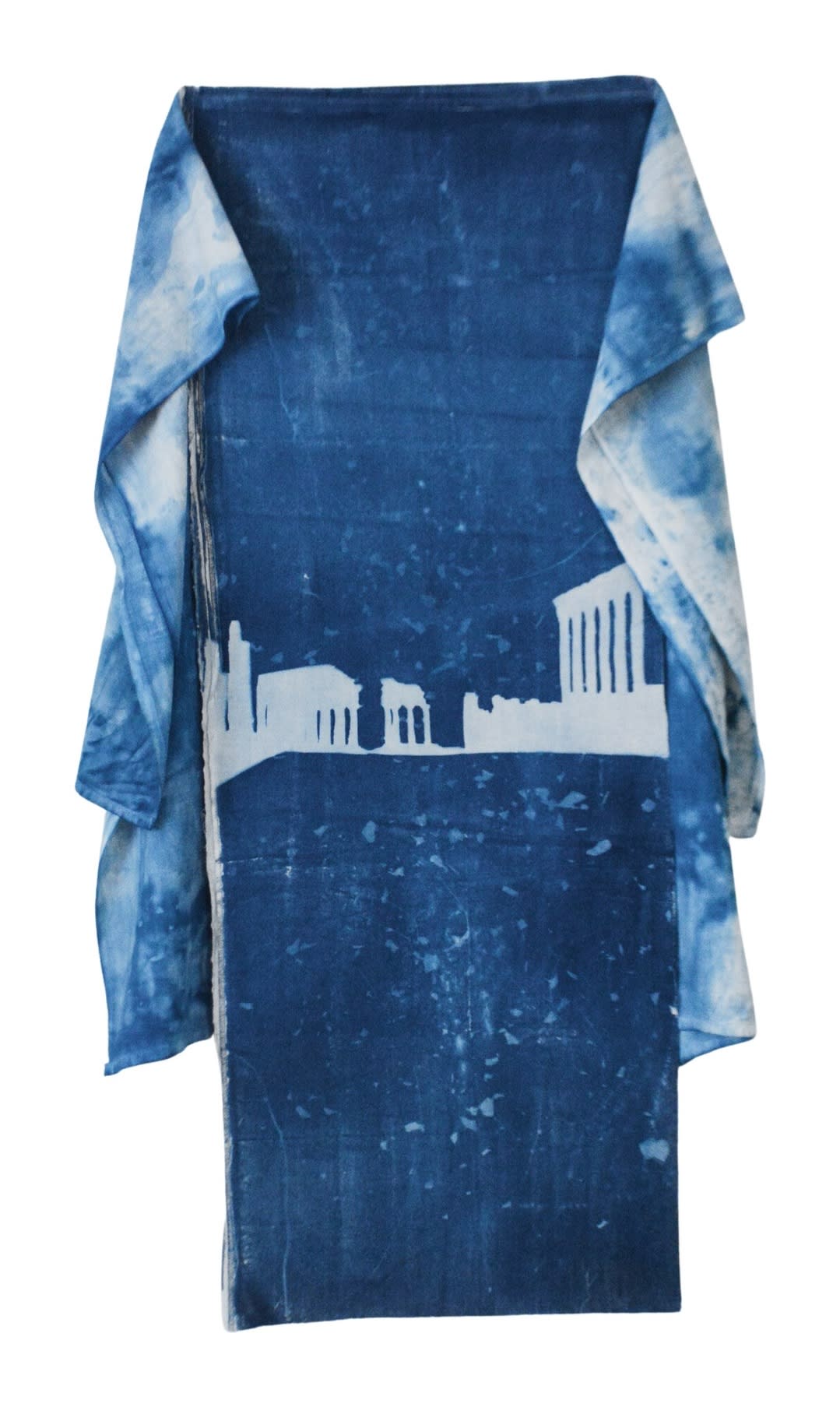
Behind the lounge windows, in full daylight, Sirin Boubaker shows two cyanotypes. The process, invented in 1842 by John Herschel, was first used by Anna Atkins to print her algae in white on blue in the first book illustrated with photographs, then by architects to print their plans, and Sirin Boubaker makes it the instrument of an archaeology, laying ruins onto fabric that she exposes to daylight. Dustfall is a long panel turned deep blue, crossed at mid-height by a band of ruins left in white, colonnades and stretches of wall aligned on a single horizon, on which pale flakes fall from top to bottom, while two lighter, marbled lengths of cloth fall in folds on either side and give it the look of a draped figure. Since Hubert Robert, nicknamed in the eighteenth century Robert of the Ruins, and Diderot, who saw in his canvases an occasion to meditate on all that passes, the ruin has been a subject in its own right. Sirin Boubaker changes its matter, since the same light that prints the stones also prints the dust that covers them, so that the image records the slow fall its title names at the very moment it happens.

Sirin Boubaker, Procella lenis, 2025

Artwork no. 15 : Procella lenis, 2025

Cyanotype on antique linen, red silk thread embroidery, exposed to natural light · 109 × 73 cm

€1,800approx. 1,181,000 FCFA

Write to Armature (new tab)View on Artsy (new tab)

Procella lenis is a length of antique linen, hung like a sheet, bearing a row of ruined temples reserved in white above a band of sea, with at its centre a fringed square of water set like a patch, and a red silk thread embroidered by hand following the outline of the ruins, while pale spots, foam or clouds, float at the top and bottom of the cloth. The title means a gentle storm in Latin, and this oxymoron names the suspended time in which the whole piece holds, when the ruins are neither raised nor swept away. The red embroidery, the same as in Shattered Abyss, is the only gesture of the hand in an image made by light, like a thread drawn taut to hold back what the sea threatens. The antique linen, which had a life before passing under the light, slips another memory beneath that of the temples, as if the ruin had been printed on a household's linen.

Hope Mokded

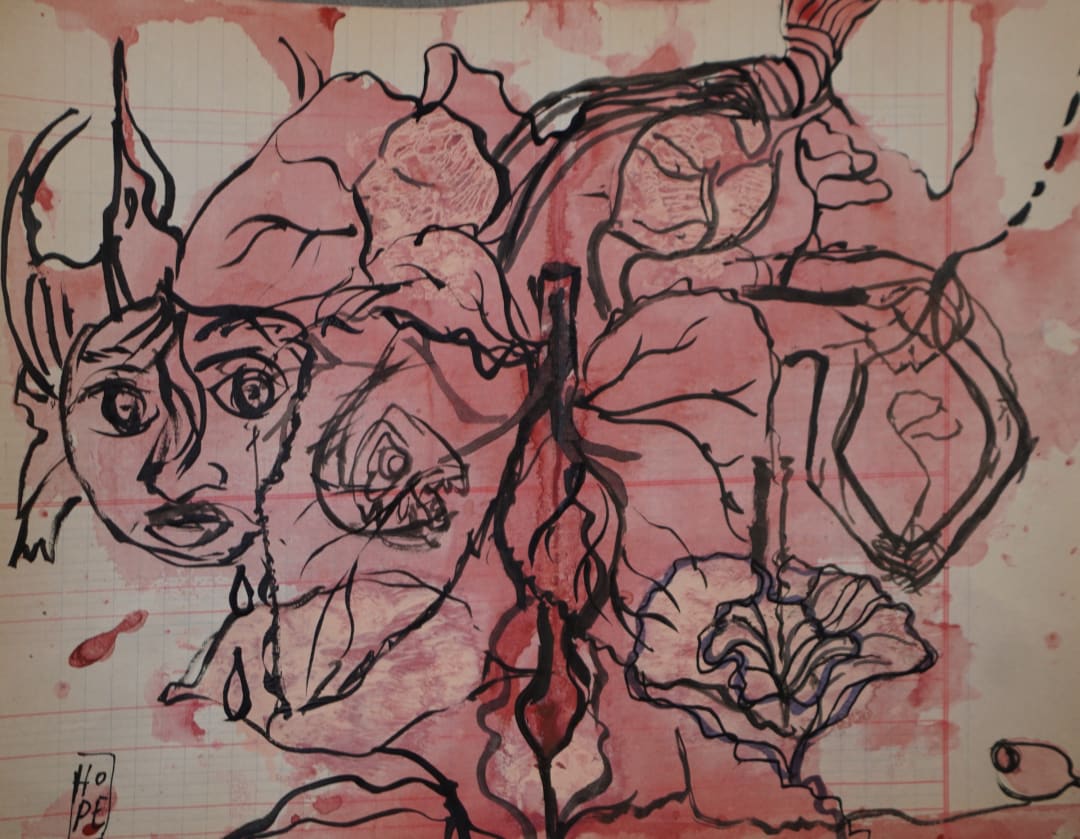
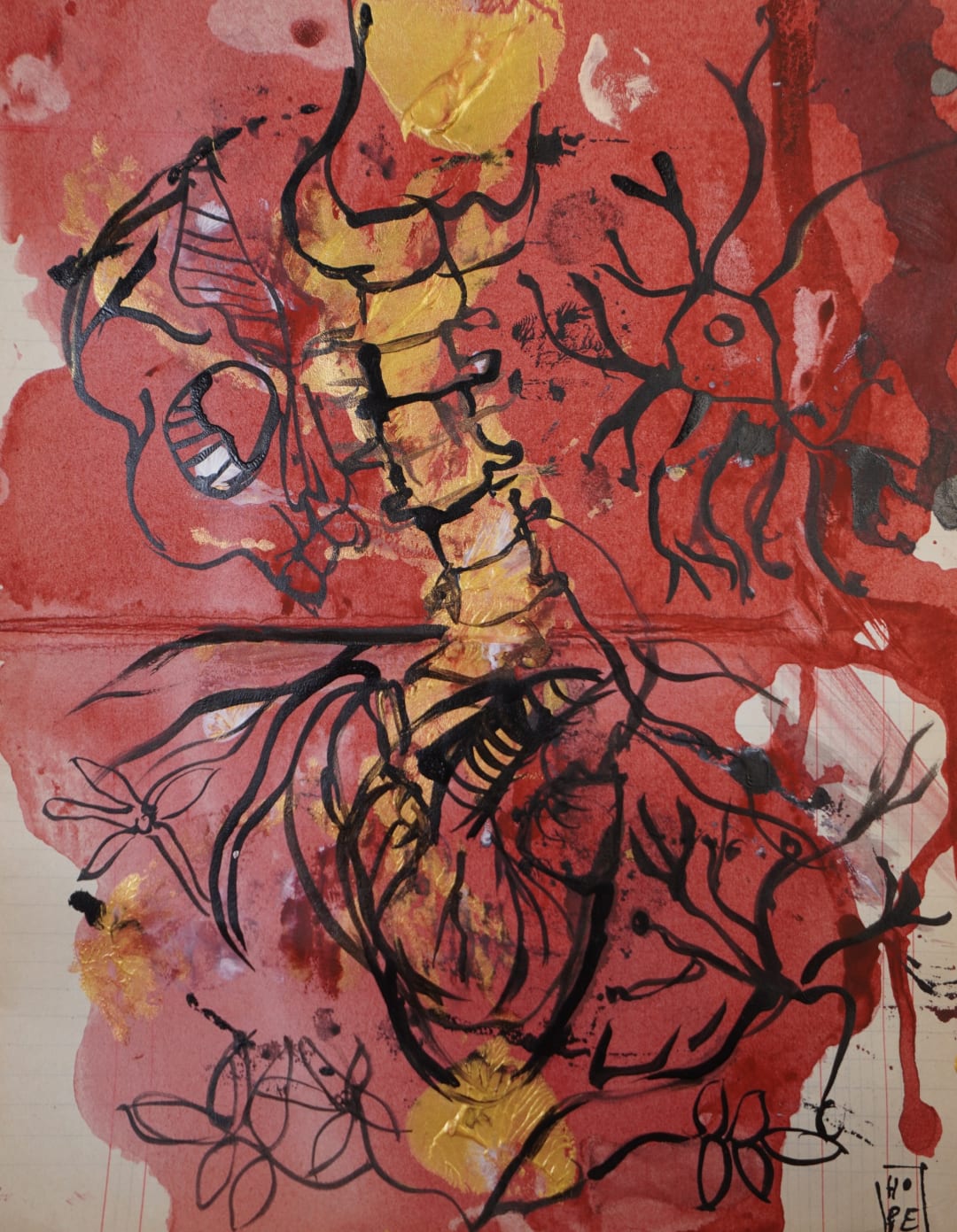
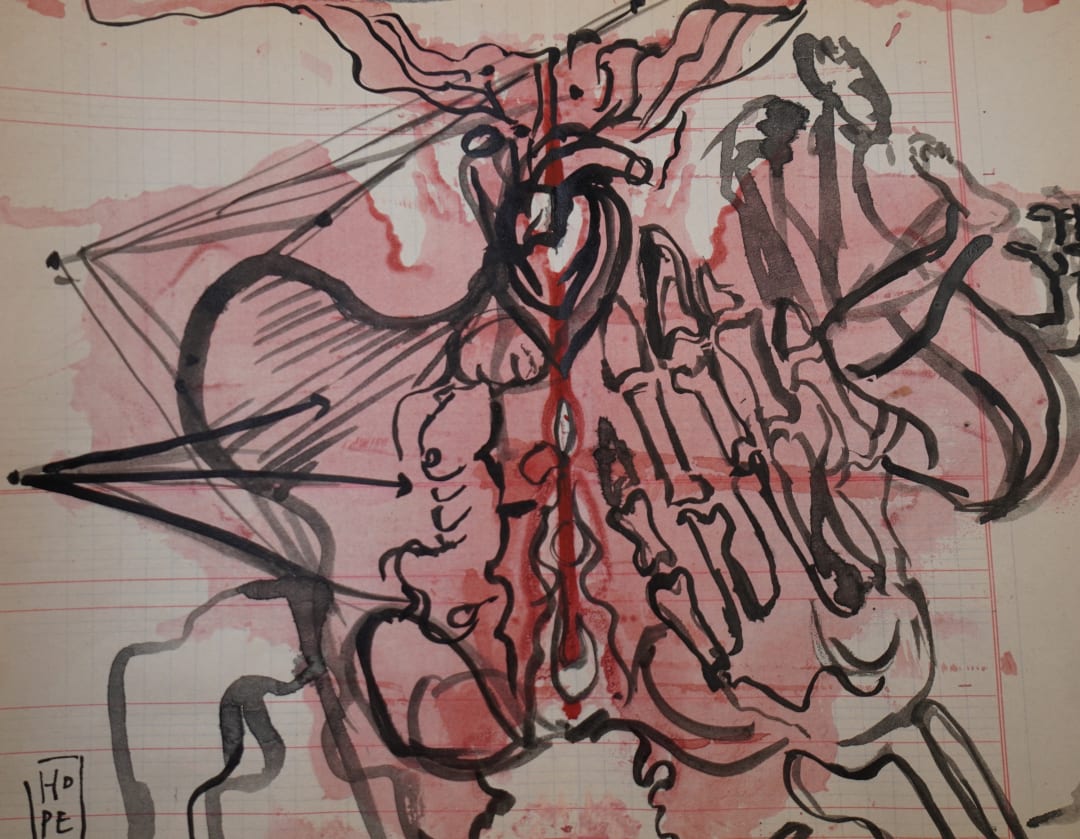
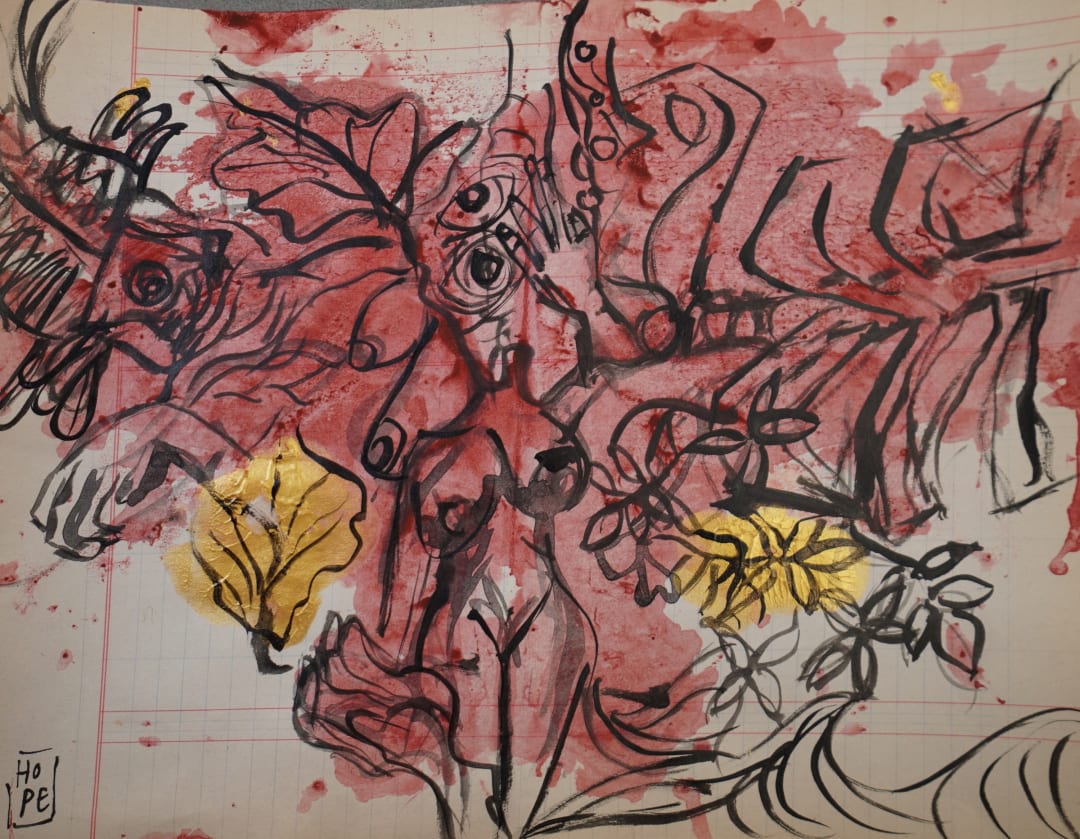
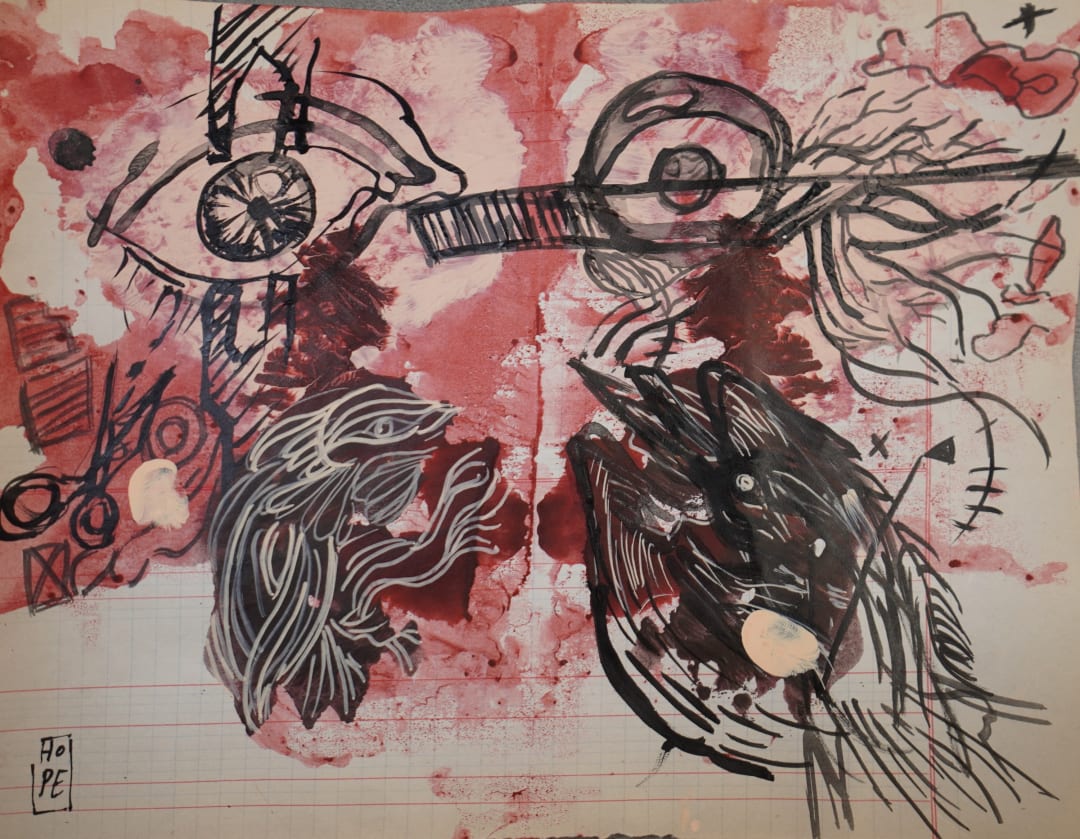
Hope Mokded, born in 1988 in Gabès, trained at the Institut supérieur des beaux-arts de Tunis and the University of Strasbourg, lives in Paris, where she is a member of the Curry Vavart collective, and her painting, like her drawing, starts from her experience as a woman, an African and an immigrant. Constellation d'un morcellement (Constellation of a fragmentation) was made in September 2026 in Paris, during the Programme Artistique Montmartre residency with Yellow Cube Gallery. On sheets from old exercise books, their lines and red margins still visible, she spreads washes of red Indian ink, then draws in black ink, sometimes heightened with yellow acrylic, faces, organs, bones, animals and flowers that never form a whole body. The exercise book is the page on which one learns to write straight between the lines, and the red ink, which is also that of the teacher who corrects, overflows everywhere on it. The title names what psychoanalysts call the fragmented body, the one not yet gathered into a single image. Hope Mokded makes it the figure of exile, seen from what migration does to the body and to intimacy rather than from the journey from one country to another. One thinks of the red gouaches of Louise Bourgeois's last years, except that Hope Mokded's bodies are never whole and their pieces are scattered without order on the wall reserved for them.

Hope Mokded, Constellation d'un morcellement : séquence 1, 2026

Artwork no. 16 : Constellation d'un morcellement : séquence 1, 2026

Red and black Indian ink and acrylic on old exercise-book paper · 21 × 26.5 cm

€350approx. 230,000 FCFA

Write to Armature (new tab)View on Artsy (new tab)

Sequence 1 spreads a pink wash that lets the lines of the exercise book show through, and a black stem rises through the middle of the sheet, branching like a network of veins, so that plant and bloodstream merge in a single line. On the left, a woman's face with wide-open eyes sheds two tears beside a head with pointed teeth, and on the right a lozenge encloses another shape above a flower opening like a fan. The weeping face and its sharp-toothed neighbour stand side by side like two states of one person, between grief and bite, while the flower opposite opens all the same.

The artist

Hope Mokded (b. 1988, Gabès, Tunisia) is a multidisciplinary artist who lives and works in Paris, where she is a member of the Curry Vavart collective. Trained at the Institut supérieur des beaux-arts de Tunis and at the University of Strasbourg, she works across painting, drawing, printmaking, video and performance, with a practice grounded in her experience as a woman, African and immigrant. Her large mixed-media canvases gather the voices of migrant women in dense, polyphonic compositions, from Cartographie des risques to Les clandestines (2022). Her drawings in ink, wash and gouache, such as the series De l'exil à l'asile, return again and again to a single figure, her own, in a line that keeps its hesitations and lets red spread across the sheet. Her films and performances draw on burlesque and silent cinema. She has shown in Paris, Tunis, Nîmes and Strasbourg and at BOZAR in Brussels, where she worked with the European Commission as an expert artist.

View Hope Mokded’s page

Hope Mokded, Constellation d'un morcellement : séquence 2, 2026

Artwork no. 17 : Constellation d'un morcellement : séquence 2, 2026

Red and black Indian ink and acrylic on old exercise-book paper · 26.5 × 21 cm

€350approx. 230,000 FCFA

Write to Armature (new tab)View on Artsy (new tab)

The only upright sheet of the series, sequence 2 is also the most saturated with red. A column of vertebrae runs through it from top to bottom between two patches of yellow acrylic, the fold of the exercise book cuts it halfway down like a fracture, and around it spread ribs, a cell with long branching arms, roots and, at the bottom, five-petalled flowers drawn in a single line. The roots drawn beside the spine take exile at its word, the word uprooting. Hope Mokded thus gives the body the structure of an uprooted plant, whose backbone would be the stem.

Hope Mokded, Constellation d'un morcellement : séquence 3, 2026

Artwork no. 18 : Constellation d'un morcellement : séquence 3, 2026

Red and black Indian ink and acrylic on old exercise-book paper · 21 × 26.5 cm

€350approx. 230,000 FCFA

Write to Armature (new tab)View on Artsy (new tab)

In sequence 3, a red line runs down the middle of the sheet like a spine, with a heart at its top, ribs and bones crowd the right-hand side, and on the left straight lines ending in dots and arrows point at the body like the labels of an anatomical plate. Since Andreas Vesalius's Fabric of the Human Body, in 1543, the anatomical plate has named every part it points to. Here the arrows lead to no word, so that the body, pointed at from all sides, is examined like that of a stranger whose name no one has asked.

Hope Mokded, Constellation d'un morcellement : séquence 4, 2026

Artwork no. 19 : Constellation d'un morcellement : séquence 4, 2026

Red and black Indian ink and acrylic on old exercise-book paper · 21 × 26.5 cm

€350approx. 230,000 FCFA

Write to Armature (new tab)View on Artsy (new tab)

Sequence 4 places between two patches of yellow acrylic, on which foliage is drawn, a horse's head with staring eyes that dominates the sheet, with a small naked female body beneath its nostrils, while at the upper left a horned head opens its jaws and on the right flowers and a branch spill out of the red stain. Art history has an image for this encounter, The Nightmare, painted by Johann Heinrich Füssli in 1781, in which a horse's head with bulging eyes looms above a sleeping woman on whom a demon has sat down. Hope Mokded keeps the horse's head and the horned creature, but the woman is now no more than a small standing figure, tiny beneath the beast's nostrils, in a bad dream the body does not wake from.

Hope Mokded, Constellation d'un morcellement : séquence 5, 2026

Artwork no. 20 : Constellation d'un morcellement : séquence 5, 2026

Red and black Indian ink and acrylic on old exercise-book paper · 21 × 26.5 cm

€350approx. 230,000 FCFA

Write to Armature (new tab)View on Artsy (new tab)

In sequence 5, a red line drops from the top edge, crossed by short black dashes like a suture, into a large stain where a black wing with grey feathers, a head with a ringed eye and, on the right, a round eye circled twice come together, beneath two touches of yellow acrylic that light up the top of the sheet. The suture, which recurs from one sheet to another, inscribes the gesture of repair in the drawing itself. Here it leads to a wing without a bird, detached from any body, like the remnant of a flight that no longer carries anyone, under the twice-circled eye that stares at the visitor.

Hope Mokded, Constellation d'un morcellement : séquence 6, 2026

Artwork no. 21 : Constellation d'un morcellement : séquence 6, 2026

Red and black Indian ink and acrylic on old exercise-book paper · 21 × 26.5 cm

€350approx. 230,000 FCFA

Write to Armature (new tab)View on Artsy (new tab)

Sequence 6 sets two human skulls and a long-beaked bird's skull floating above a mass of wavy lines, with flowers with closed buds on the left and, on the right, a large bird's head that stares at the viewer with a round eye. Skull and flower are the two signs of the vanitas, the still life that reminded the seventeenth century that beauty passes and death comes. Hope Mokded sets them above lines that look like rough water. From an artist from Gabès who works on exile, skulls floating above waves call to mind the Mediterranean turned into a cemetery. The flowers, for their part, keep their buds closed, like a life that will not have had time to bloom.

Hope Mokded, Constellation d'un morcellement : séquence 7, 2026

Artwork no. 22 : Constellation d'un morcellement : séquence 7, 2026

Red and black Indian ink and acrylic on old exercise-book paper · 21 × 26.5 cm

€350approx. 230,000 FCFA

Write to Armature (new tab)View on Artsy (new tab)

In sequence 7, the red stains answer each other from one half of the sheet to the other, on either side of the fold, as in the test the psychiatrist Hermann Rorschach published in 1921, in which someone is asked what they see in an ink blot. Above, a wide-open eye is pierced by a long hatched bar that runs to a ring, below, two heads face each other, one drawn in white lines and the other in black, like a figure and its negative, and along the edges a pair of scissors, crosses and a row of stitches can be made out. The drawing then puts two questions to the visitor, what has been cut and what has been sewn back. Well, a body, of which the sheet keeps only pieces held at a distance, like the stars of a constellation.

5 works

Terrace

Axel Derriks, Forêt de l'EcoPark, Casamance, 2021

Artwork no. 23 : Forêt de l'EcoPark, Casamance, 2021

Pigment print on Canson Baryta Photographique II Matt 310 gsm, face-mounted on satin acrylic (Diasec), aluminium · 70 × 110 × 0.6 cm

€4,500approx. 2,952,000 FCFA

Write to Armature (new tab)View on Artsy (new tab)

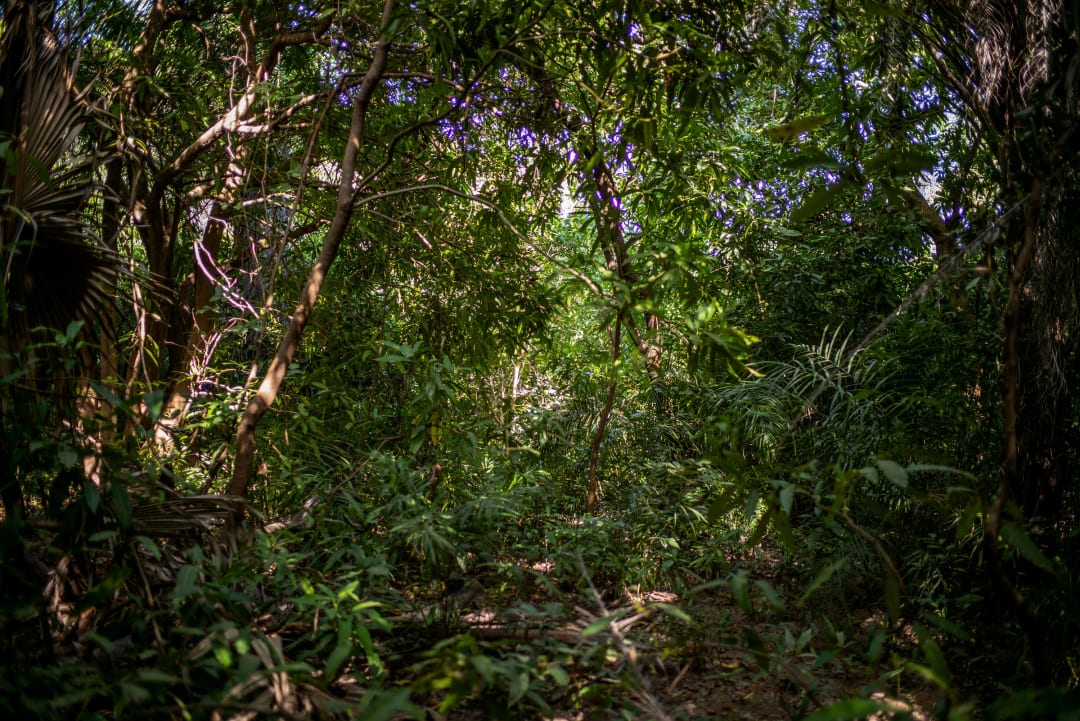
Axel Derriks, a Belgian photographer born in 1977, lived for twenty years in Africa, from Mauritius to Senegal by way of Tunisia, Egypt and Burkina Faso, and devoted more than fifteen years, with the historian Virginie Prévost, to a photographic survey of the places of worship of Djerba, nearly forty-five thousand exposures for five hundred and ninety-three sites. The five images he shows on the terrace were taken in Senegal in 2020 and 2021, in Casamance and in the southeast, and they keep from this work of inventory a way of looking at matter rather than monument. In the EcoPark forest in Casamance, palm fronds and vines, among young trunks, fill the whole frame, from the leaf litter on the ground up to the canopy where a few patches of sky show through, with neither horizon nor central subject. The tropical forest carries with it the image of Eden or that of the threatening jungle, both born of the European gaze, and the Douanier Rousseau painted his at the Jardin des Plantes without ever having left France. Axel Derriks sets both aside by treating the forest as a survey, of equal intensity from edge to edge, where the eye finds no resting point and must travel through the image as one moves forward under the cover of the trees.

The artist

Axel Derriks photographs sacred and vernacular architecture the way one records a script on the verge of being erased. Born in Belgium in 1977, he lived and worked in Africa for twenty years, from Mauritius to Senegal by way of Tunisia, Egypt and Burkina Faso. For more than fifteen years he documented, with the historian Virginie Prévost, the Ibadi mosques of Djerba, low sanctuaries whitewashed in white and blue and bristling with buttresses, many of them falling into ruin: close to forty-five thousand exposures for five hundred and ninety-three sites, and two reference publications, including "Résistance et dévotion. Anciens sanctuaires ibadites de Djerba" (British Institute for Libyan and Northern African Studies, London, 2023). His photography looks less for the monument than for matter and light: the grain of lime wash, the shadow of a dome at dawn, the humble geometry of a village. In Senegal, where he lived for several years before returning to Brussels in 2026, he turned this gaze to the mangroves of Casamance, the island of Gorée and Bassari country, in the Kédougou region. Five of these images, taken in 2020 and 2021, were shown for the first time in Dakar in 2026, in the OFF programme of the 16th Biennale.

View Axel Derriks’s page

Axel Derriks, Masque bassari, Etiolo, 2021

Artwork no. 24 : Masque bassari, Etiolo, 2021

Pigment print on Canson Baryta Photographique II Matt 310 gsm, face-mounted on satin acrylic (Diasec), aluminium · 50 × 50 × 0.6 cm

€2,200approx. 1,443,000 FCFA

Write to Armature (new tab)View on Artsy (new tab)

The mask is the commonplace of African art, the one Europe has kept for more than a century under glass cases like an object of wood, forgetting that it is worn and that it is ritual, so that for a European photographer on this continent there is no subject more of a trap. On 29 December 2021, in Etiolo, in Bassari country, Axel Derriks photographed a mask of woven fibre, trimmed with still-green leaves, whose eyes are the necks of two blue plastic bottles, and the print frames it so closely that only one of these bottle necks holds the centre of the image, between the weave of the fibre, a pale band across the forehead and the leaves. He photographed it as one photographs someone, from the front, very close, the focus on the eye as in any portrait, and at the bottom of the bottle neck appears the wearer's eye, with a point of light in the pupil. The industrial plastic, become the mask's gaze, shows a rite that lives in the present and makes do with what is picked up by the roadside. For to look a mask in the face, at the distance at which one looks at a face, is above all to recognise that there is someone beneath it.

Axel Derriks, Îlot des Féticheurs, mangroves de Casamance, 2020

Artwork no. 25 : Îlot des Féticheurs, mangroves de Casamance, 2020

Pigment print on Canson Baryta Photographique II Matt 310 gsm, face-mounted on satin acrylic (Diasec), aluminium · 50 × 50 × 0.6 cm

€2,200approx. 1,443,000 FCFA

Write to Armature (new tab)View on Artsy (new tab)

On the Îlot des Féticheurs, in the Casamance mangroves, Axel Derriks photographs from close up, in the shade of the trees, an altar where a bottle sheathed in green, yellow, orange and blue beads rests among pieces of broken calabash and dry leaves, beneath two hanging gourds. The word fetish, from the Portuguese feitiço, a spell, is the one European travellers and ethnographers gave to the objects of worship they did not understand, before bringing thousands of them into museums. The photographer who spent fifteen years surveying the sanctuaries of Djerba applies the same discipline here, which consists in recording the place of worship as it is, in use, without moving anything, the image leaving the altar in its place and in its light. The broken calabash and the industrial bottle, adorned with beads, are among those gathered things that the rite keeps without mending them, like the bottle necks that serve as eyes for the Etiolo mask.

Axel Derriks, Mangrove, chemin de Cap Skirring vers la Guinée-Bissau, 2020

Artwork no. 26 : Mangrove, chemin de Cap Skirring vers la Guinée-Bissau, 2020

Pigment print on Canson Baryta Photographique II Matt 310 gsm, face-mounted on satin acrylic (Diasec), aluminium · 110 × 220 × 0.6 cm

€9,000approx. 5,904,000 FCFA

Write to Armature (new tab)View on Artsy (new tab)

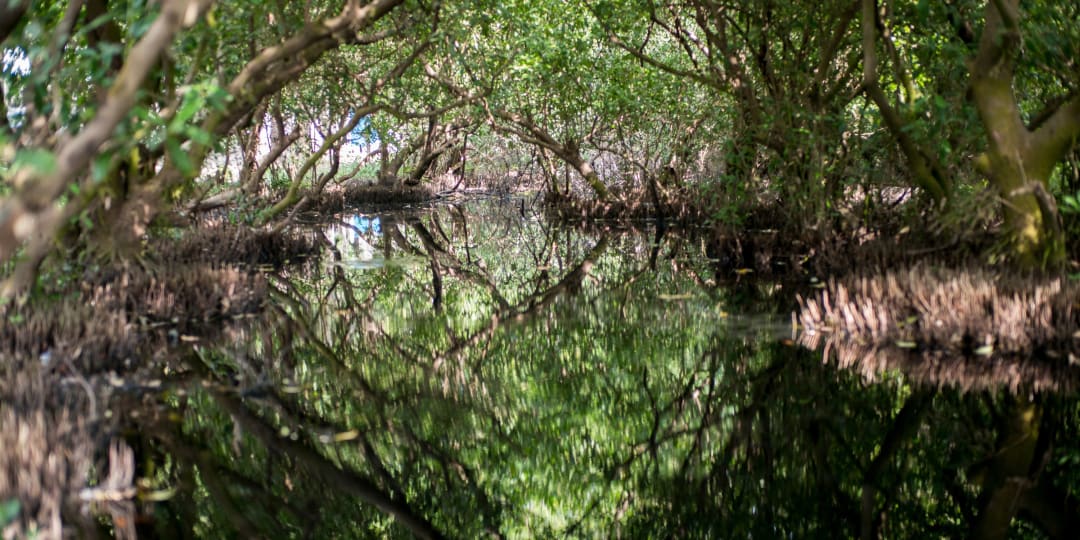
A channel of still water runs through the mangrove on the way from Cap Skirring to Guinea-Bissau, and the branches close over it so tightly that their reflection doubles the tangle, leaving at the centre only a pale opening through which the light comes. The mangrove is a threshold environment, neither quite land nor quite sea, where mangrove trees grow in salt water and hold the mud with their roots. Axel Derriks draws from it an almost symmetrical image, where top and bottom answer each other to the point that one hesitates over which way up the photograph goes. Reflection, usually the most decorative device of landscape, serves here to close the space. Only this white at the centre remains, towards which the channel leads the eye as it led the traveller towards the border.

Axel Derriks, Racines, route de Dindéfélo, 2021

Artwork no. 27 : Racines, route de Dindéfélo, 2021

Pigment print on Canson Baryta Photographique II Matt 310 gsm, face-mounted on satin acrylic (Diasec), aluminium · 110 × 70 × 0.6 cm

€4,500approx. 2,952,000 FCFA

Write to Armature (new tab)View on Artsy (new tab)

On the road to Dindéfélo, in southeastern Senegal, a tangle of roots and branches overhangs a bank of red earth, so dense that it is impossible to tell where the tree ends and the ground begins, and a corner of blue sky opens at the top right. The root is the most worn metaphor of identity, that of origins and native soil, and Édouard Glissant, borrowing an image from Deleuze and Guattari, opposed to it in 1990, in Poetics of Relation, the rhizome, roots that run in every direction and reach out to other roots. Axel Derriks's photograph shows a rhizome more than a root, since no trunk commands the whole and the roots mingle with earth and branches to the point that no beginning can be found for them. The bank of red earth, cut into by the road, holds all the same, kept in place by this network that no one planted.

End of the visit

You have seen 0 of 27 works

Tap the heart on a work to find it here.

Write to ArmatureSee the exhibition on Artsy

Be contacted

Leave an email or a number, and Armature will get back to you.

Either one is enough.

No work set aside yet.

Armature uses this to reply to you, and for nothing else without your consent

Get Armature's letter

Exhibitions and news from the artists, a few times a year.

Privacy

About the exhibition

Curated by Shiran Ben Abderrazak for Armature

Contrecoup: in medicine, the injury that appears on the side opposite the point of impact, on the other side of the skull, where the blow did not land.

The 16th Dakar Biennale has taken “(Anti)fragility” as its theme, and its artistic director, Morad Montazami, describes an attitude that turns fragility into strength, through restoring what has been damaged, tending wounds and learning from shocks. Its French title ends on a word, contrecoup, which the exhibition takes literally. What becomes of the part of a shock that does not turn into strength, where does it lodge, and in what form does it return? It remains, as a displaced mark, found after the fact and elsewhere than where one was struck, with neither the stillness of a ruin nor the closure of a scar, already a form of repair.

In French that mark bears the name of a colour, un bleu, the bruise, which comes after the blow and changes hue over the days while the body works and nothing has yet been mended. And blue returns in the work of several of the artists without their having agreed on it, from the night interiors of Karima Ben Cheikh and the ultramarine canvases of Sonia Ben Slimane Besada to the Prussian blue that light fixes in the cyanotypes of Sirin Boubaker. Only one work shows the blow itself, the frieze of Ymen Berhouma, which the visitor reaches after crossing the blues, as one notices a mark before remembering what made it. Then come the bodies, what exile does to them in the inks of Hope Mokded, what excess does to them in the paintings of Zitch, and a face that holds by its sutures in Human Resources, by Jared Aufrichtig and Ryan Shava. At both ends of the route stand works where nothing is repaired and everything holds all the same, the broken eggs of Lilia El Golli at the lifts and, alone on the terrace wall facing the ocean, the five photographs Axel Derriks took in Casamance and in Bassari country.

For before repairing, one has to have looked for a long time at what was hurt, and these nine artists, from Tunis, Paris, Brussels, Copenhagen and Cape Town, show, in a city whose Biennale is devoted these days to repair, the mark the blow left, which each of them has made into a work. Seven of them were born in Tunisia or have their roots there. Yet this biennale is called, in so many words, the Biennale of Contemporary African Art. And it is among the artists of their continent that Armature chose to show them, artists more often filed under the Mediterranean or the Arab world than under Africa.

Open Tuesday to Sunday, 11 am to 7 pm, free entry.

No shock is ever transformed entirely: a part of it remains, lodged in bodies and in memories, that neither strength nor repair absorbs. This is the part the exhibition looks at, through marks that surfaced elsewhere and after the shock that made them. Opening on Saturday 21 November at 6:30 pm.

Start the visit

Get Armature's letter

Exhibitions and news from the artists, a few times a year.

Privacy

The map

You are here. You arrive by the lifts.

Tap a number to go to the work.

The works, room by room

About the exhibition

The map

The works

Tap a picture to go to the work.

Lift lobby

Terrace

The artist

Lilia El Golli

Lilia El Golli (born in 1972) is a French-Tunisian photographer and author. She lived and studied in Paris, Madrid and Dublin, and now works from her studio near Paris, with long stays in Tunisia that feed her work. Her photography, minimalist and close to surrealism, explores the "unseen", what surrounds us without catching the eye, and questions our relationship to the land, the condition of women and the gap between what is imagined and what is pictured. Shadow, light, colour and movement trace an inner journey at the edge of the mystical. Her series Broken Egg(0) (2021), from which Blooming Day and Leviathan's Glory are taken, makes the egg a motif of fertility, identity and creative resilience, linking Tunisian childhood memories to the transformation of an intimate ordeal into a new form. Her fine art prints on Hahnemühle paper are issued in limited, numbered and certified editions. Honourable mention at the Africa Photo Awards (2020) and winner of a Pro d'Or Havas (2013), she has exhibited in Paris, Tunis, Arles, Geneva and Saudi Arabia, and has collaborated with Arte, Carnet d'Art and BabelMed.

Their works in the exhibition

View the artist’s page

The artist

Sonia Ben Slimane Besada

Sonia Ben Slimane Besada (born in 1996 in Tunis) is a Tunisian-Spanish visual artist based in Copenhagen. Trained at the Atelier de Sèvres, the École nationale supérieure d'art de Limoges and then the Københavns Kunstskole, she works in painting, ceramics and sculpture. Her compositions draw on tales, poetry and the oldest of images, from the cave paintings of Altamira and Charama to the hangings of East Asia. Out of them comes a bestiary of bulls, foxes, flying fish and lemon moons, somewhere between magical realism and childhood memory. Her work has been shown in Tunis in the exhibition Musk & Amber (2025) and at Archivart Gallery with "Cette part de vestiges en moi…" (2026).

Their works in the exhibition

View the artist’s page

The artist

Ymen Berhouma

Born in Tunis in 1976 and self-taught, Ymen Berhouma has painted and drawn for twenty years. She moved from painting to drawing on paper, and founded Atelier Ymen in Tunis, a collective that shows young artists.

Their works in the exhibition

The artist

Karima Ben Cheikh

Karima Ben Cheikh (b. 1986, Tunis) is a Tunisian multidisciplinary artist who has lived and worked in Paris since 2010, where she studied art at the Sorbonne. After working in graphic design, she devoted herself entirely to art in 2021, first through watercolour, graphic novels, children's books, music, video and photography, before turning to oil painting in 2022. Her painting, expressionist and moving between figuration and abstraction, returns to two subjects: solitude, which she paints as a condition for creating, and time, which she holds to be a continuous present, so much so that she often paints new works over existing canvases. She held a solo show of thirty-four works at the Danube Palace in Paris in 2022 and has taken part in group exhibitions in Paris, among them Plurielles 2 (2022) and Agora (2023), as well as Nice Art Expo, and she was a finalist in the See.Me New Realism competition in 2023, after an honourable mention in its Evolve competition in 2022. She is a co-founder of Galerie KHÅL in Paris.

Their works in the exhibition

View the artist’s page

The artist

Zitch

Zitch is a Tunisian artist who works between painting and drawing, based in Tunis. She trained at the Institut Supérieur des Beaux-Arts de Tunis, where she took a Bachelor in Fine Arts with a painting speciality in 2022 and a research master's degree in 2024, after studies in economics and political science in Tunis and Lisbon. She began painting in 2019, with large canvases given over to ordinary and repetitive scenes, and returned in 2021 to drawing, the medium of her adolescence, to take on the patriarchal model and the conformity it produces. Feeling the Gap (2021), eighty-two small black and white drawings of scenes of sexual life shown without censorship, made the viewer's own reaction a material of the work. Her research then moved to the place women hold in public space, and to the poster as a way of occupying it. Overflow, her current body of work, turns to appetite and industrial abundance: crisps, sweets and packaging painted at close range, food leaving the image to enter the room.

Their works in the exhibition

View the artist’s page

The artist

Sirin Boubaker

Sirin Boubaker (born in 1993 in Tunisia) is a painter and visual artist. Her practice combines painting, collage, photomontage and cyanotype on fabric, and questions memory, human fragility and what time leaves behind in our inner landscapes. Her canvases are peopled with hybrid figures, skulls and the recurring motif of the black swan, messenger of the unforeseeable. She holds a master's degree in theory of creation (Institut Supérieur des Beaux-Arts de Nabeul, 2017) and has exhibited at the Institut français de Tunisie, TGM Gallery, the National Library of Tunisia and Galerie Khal in Paris, among others. She lives and works between Tunisia and France.

Their works in the exhibition

View the artist’s page

The artist

Jared Aufrichtig and Ryan Shava

Jared Aufrichtig is a South African artist, born in Long Beach, California, who lives and works in Cape Town. His practice moves between painting, printmaking, film photography and street art, with a process-led approach in which each work grows out of an experience and carries its own story. Text, collage and a pop vocabulary meet a free, almost calligraphic line and an expressionist sense of colour. Engagement runs through his work, from the question of water as a resource to the many faces a single person can wear, as in the painting Samurai Farai Three Wisemen (2021) and the Mirror Man series. Coming from graffiti and murals, he has extended his work to prints and digital editions. His work has been the subject of a text by the critic Ashraf Jamal in the South African Art Times.

Their works in the exhibition

View the artist’s page

The artist

Hope Mokded

Hope Mokded (b. 1988, Gabès, Tunisia) is a multidisciplinary artist who lives and works in Paris, where she is a member of the Curry Vavart collective. Trained at the Institut supérieur des beaux-arts de Tunis and at the University of Strasbourg, she works across painting, drawing, printmaking, video and performance, with a practice grounded in her experience as a woman, African and immigrant. Her large mixed-media canvases gather the voices of migrant women in dense, polyphonic compositions, from Cartographie des risques to Les clandestines (2022). Her drawings in ink, wash and gouache, such as the series De l'exil à l'asile, return again and again to a single figure, her own, in a line that keeps its hesitations and lets red spread across the sheet. Her films and performances draw on burlesque and silent cinema. She has shown in Paris, Tunis, Nîmes and Strasbourg and at BOZAR in Brussels, where she worked with the European Commission as an expert artist.

Their works in the exhibition

View the artist’s page

The artist

Axel Derriks

Axel Derriks photographs sacred and vernacular architecture the way one records a script on the verge of being erased. Born in Belgium in 1977, he lived and worked in Africa for twenty years, from Mauritius to Senegal by way of Tunisia, Egypt and Burkina Faso. For more than fifteen years he documented, with the historian Virginie Prévost, the Ibadi mosques of Djerba, low sanctuaries whitewashed in white and blue and bristling with buttresses, many of them falling into ruin: close to forty-five thousand exposures for five hundred and ninety-three sites, and two reference publications, including "Résistance et dévotion. Anciens sanctuaires ibadites de Djerba" (British Institute for Libyan and Northern African Studies, London, 2023). His photography looks less for the monument than for matter and light: the grain of lime wash, the shadow of a dome at dawn, the humble geometry of a village. In Senegal, where he lived for several years before returning to Brussels in 2026, he turned this gaze to the mangroves of Casamance, the island of Gorée and Bassari country, in the Kédougou region. Five of these images, taken in 2020 and 2021, were shown for the first time in Dakar in 2026, in the OFF programme of the 16th Biennale.

Their works in the exhibition

View the artist’s page

My selection

Tap the heart on a work to keep it here.